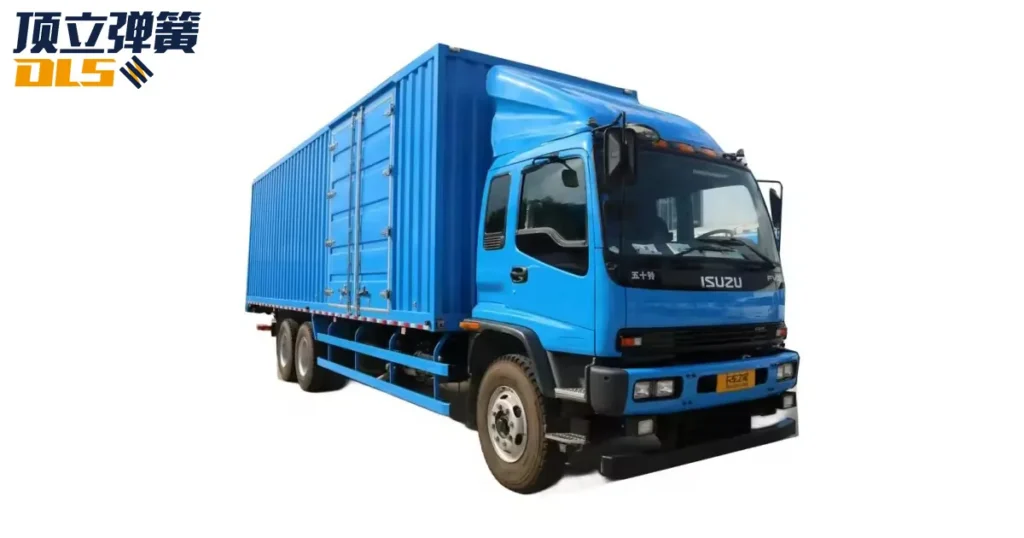
Most buyers do not think about the small spring sitting under a box truck until a side panel stops locking properly on the road. That little coil of spring steel — wrapped inside a pull-rod latch assembly under the chassis — is what keeps the cargo body sealed during long-haul vibration, hard braking, and rough loading. This article uses a real ISUZU box truck as a reference and walks through what overseas fleet engineers, OEM body builders, and aftermarket sourcing teams should look at when specifying or replacing this kind of compression spring.
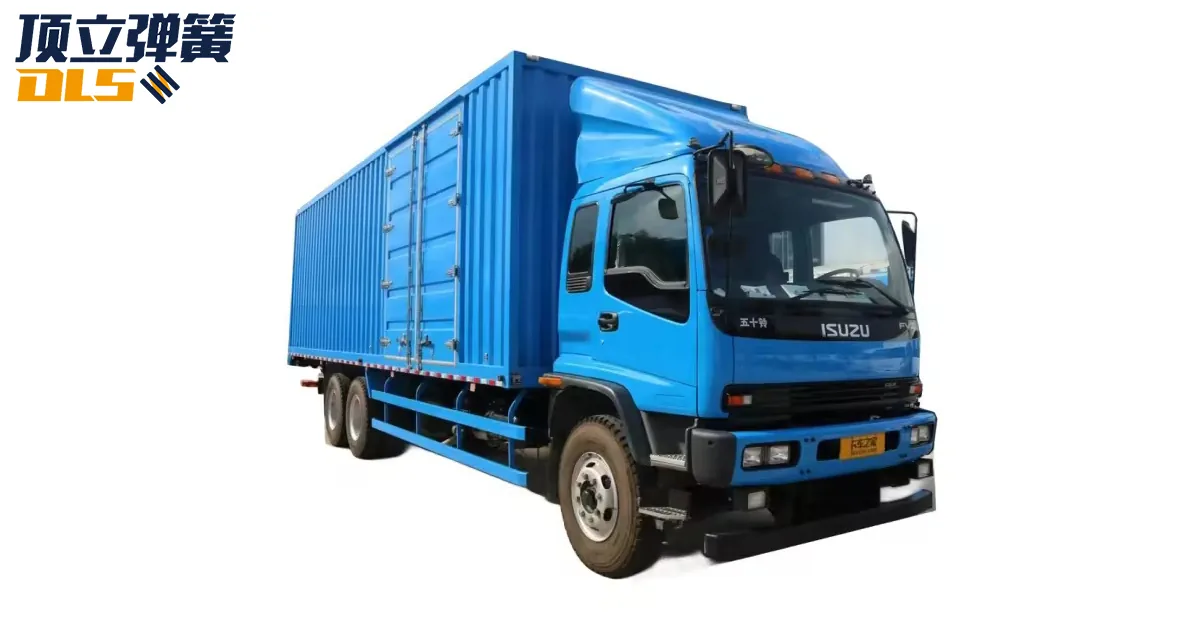
What This Spring Actually Does on a Box Truck
Look at the close-up below. You can see a heavy-duty cylindrical close-coiled compression spring with ground flat ends — not an extension spring with end hooks. The spring sits between two metal pull rods that pass through (and pinch) its end faces. One rod hooks onto a chassis crossmember, the other hooks down to the side panel locking chain. The whole assembly turns the spring’s compressed reaction force into a pulling force on the latch.
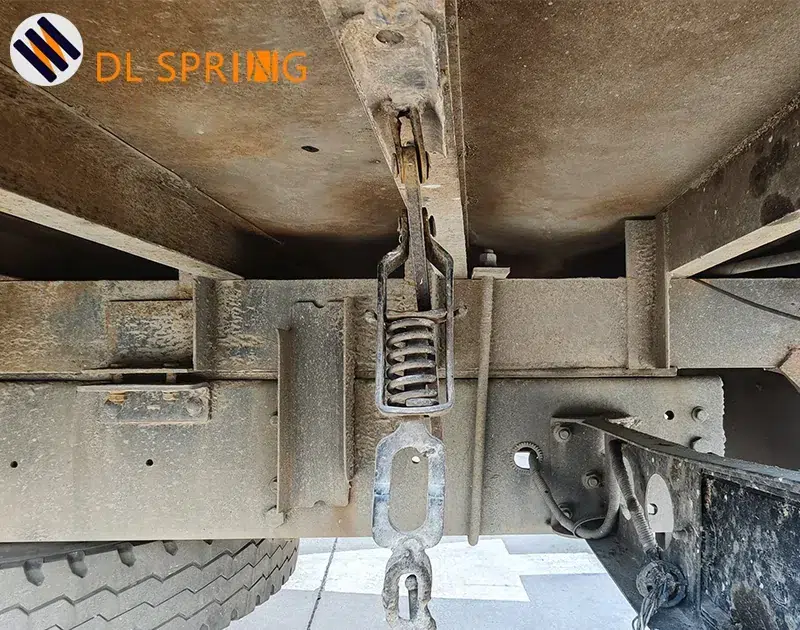
This “compression spring used to deliver pulling force” pattern works in three repeating states:
- Pre-loaded: with the side panel closed, the pull rods squeeze the spring to a defined preload, and the spring’s reaction force pulls the latch tight against the locking point.
- Released: when the operator pulls the latch handle, the assembly compresses the spring further, allowing the latch to disengage.
- Reset: when the panel closes again, the spring rebounds and pulls the latch rod back to the locked position.
So this is not a static “push-back” spring. It is a part that sits under permanent preload, sees repeated short-stroke cycles, and lives in a wet, dirty, vibrating outdoor environment. That combination is what drives the entire specification.
Five Parameters to Lock Down Before You Buy
Whether you are a body builder writing a fresh BOM, a fleet engineer ordering replacement stock, or a sourcing team comparing suppliers, these five parameters define whether the spring will hold up:
1. Free Length and Installed (Preloaded) Length
The spring must hold a defined preload after installation. Too little preload and the latch rattles or pops open on rough roads. Too much preload and the operator fights the latch handle every time, which slowly flattens the end faces and packs the closed coils solid.
2. Wire Diameter and OD (Spring Index D/d)
The reference photo shows a thick wire and tightly packed coils — a typical heavy-duty compression layout. A spring index that is too high gives a low rate and invites buckling; an index that is too low pushes operating force outside the operator’s comfort range.
3. End Configuration
For latch hardware, both ends are normally closed and ground (squared and ground). Ground ends sit flat against the pull-rod cup and distribute load evenly. Closed-only or open ends will dent, settle unevenly, and cause the reaction force to drift.
4. Preload (P1) and Maximum Working Force (P2)
Preload is the most under-specified value on this kind of drawing. For latch hardware it must match the latch’s actual locking force window. P1 too low and the panel rattles loose; P1 too high and the driver cannot release it without abuse, which deforms the end coils. P1 refers to the installed state, not the free state. You can see how we approach this in our compression spring category.
5. Surface Treatment
Chassis-mounted springs live in rain, mud, brake dust, and road salt. Plain blackening or oil-only finishes simply do not survive year-round outdoor service in coastal, mining, or salted-road regions. We cover the trade-offs between zinc plating, electrophoretic coating, powder coat, and Dacromet in our surface treatment process page.
Why “Same Looking” Springs Have Very Different Service Lives
Latch compression springs that look almost identical on the shelf can deliver very different service life on the road. The differences come from three places:
- Material: high-carbon spring wire (e.g. SWB / SWC class) or alloy spring steel wire is standard for heavy outdoor duty. Low-carbon substitutes take permanent set quickly and the spring keeps shrinking in free length, which silently bleeds preload.
- Winding accuracy: the closely wound body, the closed-and-ground ends, and the transition coils all rely on tight winding control. Sloppy end forming creates uneven seating, load shifts to the middle coils, and that is where the spring usually fatigues first. See how we wind these in our spring winding process page.
- Stress relief / heat treatment: skipping the post-forming stress relief is a common cost-cutting trick. The spring will pass first inspection, then creep under preload after a few weeks, which is exactly when latches start rattling open.
A buyer comparing quotes only on price will almost always end up paying twice — once for the cheap spring, and again for the warranty calls.
Failure Modes You Will See in the Field
From returned samples and field reports, latch compression springs on box trucks fail in four recurring ways:
| Failure Mode | Field Symptom | Most Common Root Cause |
|---|---|---|
| Permanent set (set loss) | Free length shortens, preload drops, latch loosens | Low-grade wire and / or skipped stress relief |
| Mid-coil fatigue fracture | Spring breaks somewhere in the middle coils | Stress concentration in the active coils + repeated cyclic compression |
| Coil corrosion and lock-up | Latch needs a sharp pull before it releases | Insufficient surface treatment for outdoor service |
| Buckling or side-bend | Coil axis misaligned, end faces no longer parallel | Pull-rod misalignment + soft wire + impact loading |
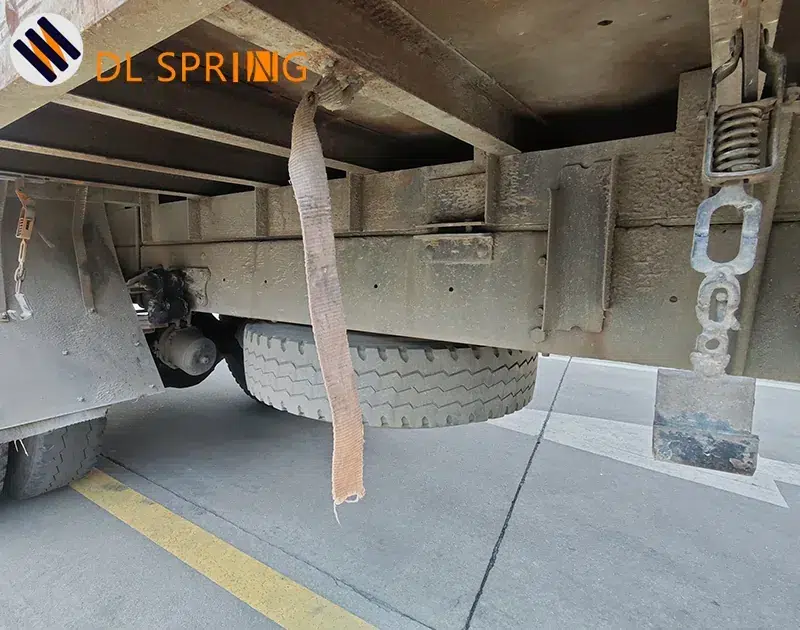
Because most box trucks use multiple latch assemblies per side, it rarely makes sense to wait for one to fail. The better practice is set-based replacement on a service interval.
How to Brief a Spring Manufacturer
If you are sourcing this part — either for a new truck body program or as an aftermarket replacement — confirm these items before sending an RFQ:
- Free length, installed (preloaded) length, and maximum compressed length (mapped to the latch stroke)
- Required preload P1 and maximum working force P2
- Wire material (carbon spring wire / alloy spring wire / stainless)
- End configuration: closed and ground, closed only, or open
- Surface finish target (zinc plating + passivation, electrophoresis, powder coat, Dacromet)
- Operating environment (long-haul, mining, coastal, refrigerated, salted roads)
- Expected service life and replacement interval
- Annual volume and packaging preference
If some of these are still open, send the existing sample or a control drawing and let the spring manufacturer reverse-engineer the missing dimensions. We routinely do this through our custom spring service, which is faster than guessing on a clean-sheet drawing.
Common Sourcing Mistakes
- Copy-from-OEM-only: the original part may already be marginal for your duty cycle; route, climate, and load can shift over a vehicle’s life.
- Buying on unit price alone: latch springs are cheap individually, but failure cost includes repeat service calls and panel damage.
- Leaving the surface finish blank: suppliers will quote the cheapest finish by default and your part will rust within a season.
- Not specifying stress relief: drawings that only call out dimensions invite suppliers to skip the heat-treatment step that controls long-term preload stability.
Frequently Asked Questions
What spring wire is typical for heavy-duty truck latch compression springs?
High-carbon spring wires such as SWB or SWC class are standard for outdoor heavy-duty service. Alloy spring steel wires are used when fatigue life or temperature range pushes higher. Stainless wires are an option for coastal or chemically aggressive routes, with a cost premium.
Should I just specify a thicker, longer spring to be safe?
No. Thicker wire raises the rate and pushes operator force above the latch design window. Longer free length without matching installed length reduces preload and lets the panel rattle. The spring needs to be sized to the latch stroke and locking force, not “as heavy as possible.”
How many latch assemblies are typically on each side of a box truck?
It depends on body length, panel segmentation, and how many locking points are used. The common pattern is one matched assembly per locking point per side, all built to the same drawing so spares are interchangeable.
What surface finish is recommended for outdoor truck duty?
For long-haul, mining, salted-road, and coastal service, plan on more than zinc plating alone. Electrophoretic coating, powder coat, or Dacromet are common upgrades. The right choice depends on cost target, color requirement, and corrosion exposure.
I only have a worn sample, no drawing. Can it still be quoted?
Yes. Send the sample. Free length, wire diameter, OD, end configuration, and approximate preload can be reverse-measured, and the working specs can then be confirmed against your latch stroke and force window before tooling.
How often should fleet maintenance check these springs?
Fold them into the regular chassis inspection interval. Look for coils stuck together, surface rust, end-face dents, and free length shortening. If any one spring shows symptoms, replace the matched set on that side rather than swapping a single coil.
Work With Dingli
If your truck body program, fleet maintenance line, or aftermarket SKU list still relies on under-specified latch compression springs, we are happy to review your drawings or sample parts and confirm a stable specification — wire grade, geometry, preload, end configuration, and finish — before any tooling is committed. Reach out at [email protected] or WhatsApp +86 13586942004, or send your sample through our contact page. You can also browse our spring product overview or learn more about Dingli.