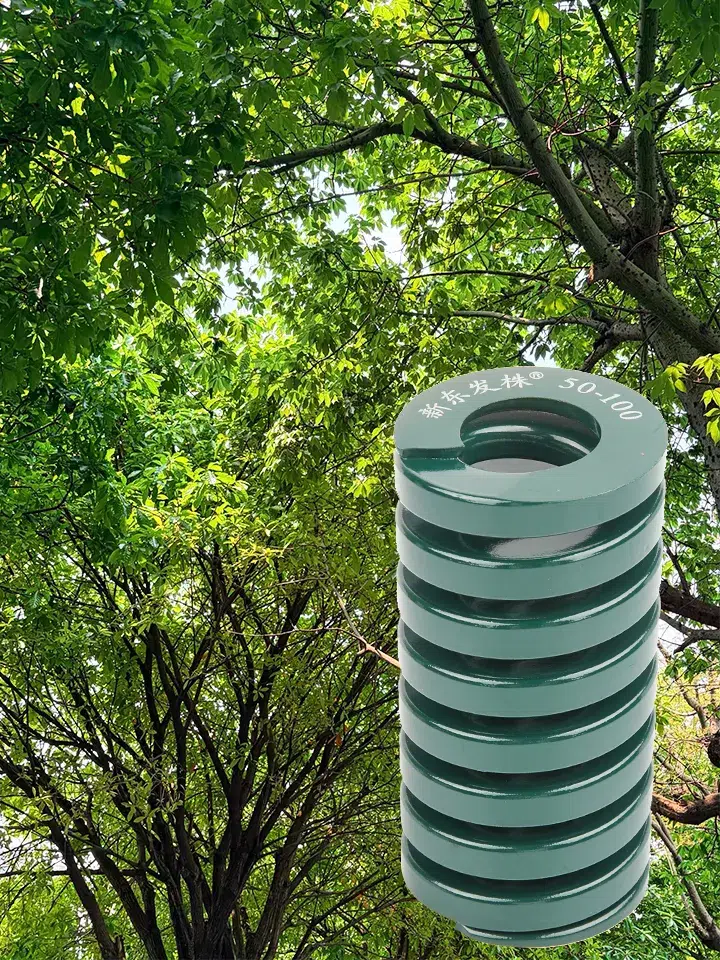
In English, the word spring can point in two very different directions. It can describe the season when trees turn green, weather becomes milder, and people start thinking about outdoor travel. It can also describe a mechanical part that stores force and returns motion. For native speakers, context usually makes the difference obvious. For international buyers, translators, new sourcing staff, and non-engineering readers, that difference is not always immediate.
That is why the phrase green spring can be surprisingly ambiguous. In a lifestyle article, it sounds seasonal. In a tooling catalog, it can point to a color-coded industrial part. The contrast becomes even stronger when the article opens with fresh green tree imagery and then turns to a die spring discussion. The visual language suggests springtime. The technical language points to mold components, load control, installation space, and replacement planning.
This is not just a language curiosity. In cross-border manufacturing, wording shapes how people search, compare, translate, and finally buy components. If the term is vague, the RFQ can become vague. If the product type is misunderstood, replacement mistakes become more likely. Using the green JIS die spring as an example is helpful because it makes the difference very easy to see: green trees are about the season, while a green die spring is about industrial identification inside a tooling system.
Why the word “spring” causes confusion in international business
English often assigns multiple meanings to one short word, and spring is a classic example. Search behavior, image-based content, and multilingual communication make that ambiguity more visible than it used to be. A buyer may start with a broad search. A marketing editor may choose a conceptual image before reading the product section carefully. A translator may see the word without enough surrounding technical signals. When that happens, people can temporarily attach the wrong meaning to the page.
In industrial content, that confusion usually appears in three places:
- when a generic word is used without the exact spring type,
- when a conceptual image is stronger than the technical explanation, or
- when procurement, engineering, and content teams do not use the same vocabulary.
The fix is not to avoid creativity. The fix is to define the term clearly once the article moves past the hook. A spring landscape can open the idea, but the body has to explain the component without delay.
| Word or phrase | Meaning | Typical context | What the reader should expect |
|---|---|---|---|
| spring | the season | travel, weather, scenery, lifestyle | time of year, mood, outdoor activity |
| spring | a mechanical part | equipment, components, engineering | force, movement, dimensions, installation |
| die spring | a tooling spring family | molds, stamping, dies, maintenance | selection logic, standards, replacement planning |
Once the phrase die spring appears, the seasonal meaning should disappear from the buying logic. From that point forward, the right questions are technical, not seasonal.
Spring the season and die spring the component are not the same category
In a travel article, spring means fresh leaves, better weather, and visual renewal. In an industrial article, a spring is a force-storing part. These are not two shades of the same idea. They belong to completely different categories of language.
A die spring is not a poetic or marketing-heavy way to describe a regular spring. It is a specific industrial term used in tooling, molds, dies, and related equipment where controlled compression behavior matters. Buyers do not choose it because the word sounds appealing. They choose it because the application demands a spring family suited to repeated movement, defined installation conditions, and practical replacement handling.
This is also why not every spring is a die spring. A site may offer many types of springs, including compression springs for broader applications, but die springs sit inside a narrower tooling conversation. They are usually discussed together with mold fit, standard systems, stroke, service logic, and catalog family compatibility.
For non-engineers, one simple rule helps immediately: if the page talks about dies, molds, stamping, load behavior, or replacement systems, then the word spring is not seasonal language anymore. It is component language, and the exact spring type matters.
| Type | Typical use | Main buying focus | What should be confirmed |
|---|---|---|---|
| General spring language | everyday speech or broad product discussion | basic category recognition | what kind of spring is actually meant |
| Compression spring | general mechanical compression applications | dimensions and working conditions | fit, force behavior, material, environment |
| Die spring | molds, dies, tooling systems | standard family, stroke, installation, replacement | application logic, catalog match, maintenance route |
That difference is what makes the title of this article useful. It separates a familiar everyday word from a specific engineering term, which is exactly what global industrial content often needs to do.
What makes a die spring different from an ordinary spring discussion
When engineers discuss a die spring, they are not speaking in generalities. They are usually thinking about space limits inside a mold, how the spring will behave over repeated cycles, and whether future maintenance will be clear and manageable. The conversation quickly becomes more structured than a general product inquiry.
That structured thinking is one reason die spring terminology must stay precise. If an inquiry simply asks for a “green spring,” the supplier still does not know whether the customer means a decorative color preference, a recognized product series, or a loosely remembered replacement part. Precision starts when the buyer names the product properly and adds the right technical context.
In real sourcing work, a useful die spring conversation usually includes several questions:
- Is the application clearly a die or mold application?
- Which standard family is the project following?
- What installation space is available?
- What working stroke and motion behavior must the spring support?
- How will replacement happen after the tool is in service?
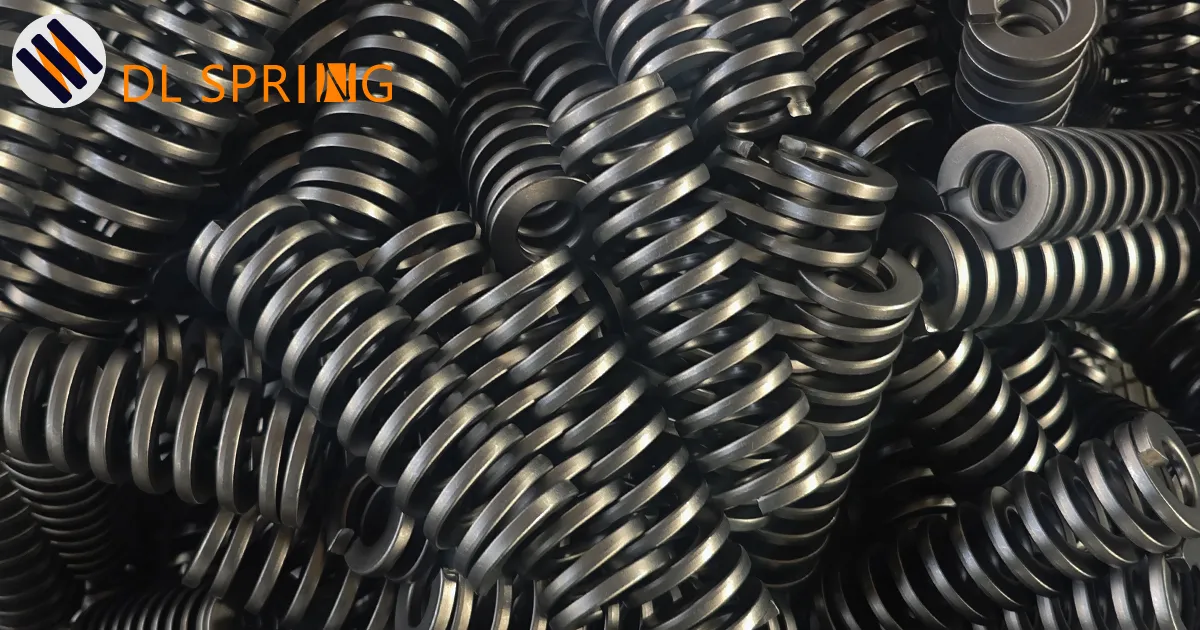
This is also why process awareness matters. Even when the standard family is correct, real-world consistency still depends on how the spring is produced and controlled. Looking at a supplier’s spring winding process helps buyers understand that product naming alone is not enough. A die spring has to be the right family, and it also has to be manufactured with repeatability that makes sense for tooling use.
So the phrase die spring carries more than a component name. It carries an application environment, a selection method, and a support expectation.
What a green JIS die spring really means
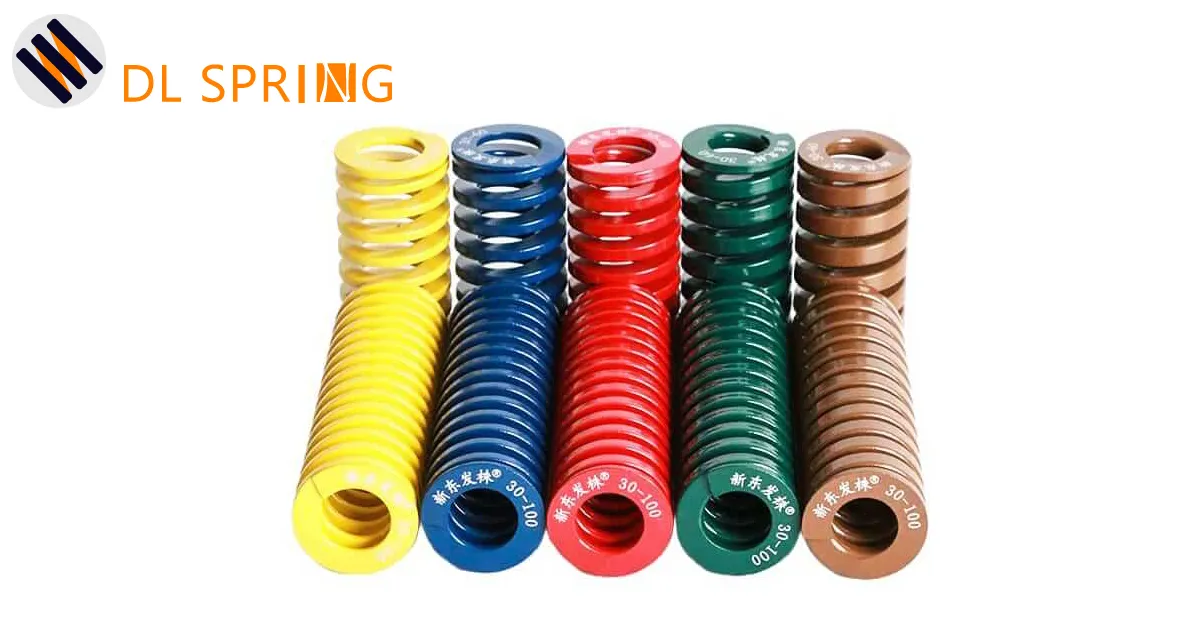
The green JIS die spring is a strong teaching example because it makes two different meanings of green easy to compare. In a spring landscape photo, green suggests fresh growth, seasonal scenery, and the mood of outdoor change. In a JIS-oriented die spring catalog, green belongs to an industrial identification system. It is not emotional language. It is operational language.
JIS points readers toward a Japanese Industrial Standards-based die spring framework. Within many die spring product families, colors are used to distinguish one series or load class from another so that technicians, buyers, and maintenance staff can recognize product families faster. A green die spring therefore does not mean “for springtime,” “eco,” or “outdoor.” It means the color is helping identify the spring inside a defined industrial system.
The exact rating or equivalence still has to be checked against the supplier’s catalog, drawing, and series data. That point matters because color alone is not a complete specification, and different product systems should never be treated as interchangeable just because they look visually similar. But the core lesson stays the same: the green color on a die spring is part of engineering identification, not a seasonal symbol.
| Green in spring scenery | Green on a JIS die spring |
|---|---|
| signals season, trees, travel mood, and visual freshness | signals recognition inside a technical product family |
| used to create emotional association | used to support selection and identification |
| can be understood without specifications | must still be matched with the catalog and application data |
This difference is useful for more than a clever headline. It teaches buyers not to read industrial products through lifestyle assumptions. If the spring is a die spring, then the questions should be about fit, family, and function, not about color mood.
What buyers should check beyond color
Color can help recognition, but it cannot close the selection process. That is one of the most important practical lessons in this article. A buyer should never assume that one green die spring can replace another without confirming the actual technical environment.
Before ordering or approving a substitution, confirm the following:
- the standard family being used, such as the relevant JIS-oriented system,
- the outer diameter and free length needed by the installed design,
- the working stroke and how much compression the application requires,
- the installation space and guidance conditions in the tool, and
- the customer’s expected maintenance and replacement method.
In other words, color is a fast visual shortcut only after the deeper product identity is already known. It cannot replace the drawing, the catalog reference, or the application review. This is especially important when teams compare standard families, look for aftermarket replacement, or try to match a spring from an old maintenance photo.
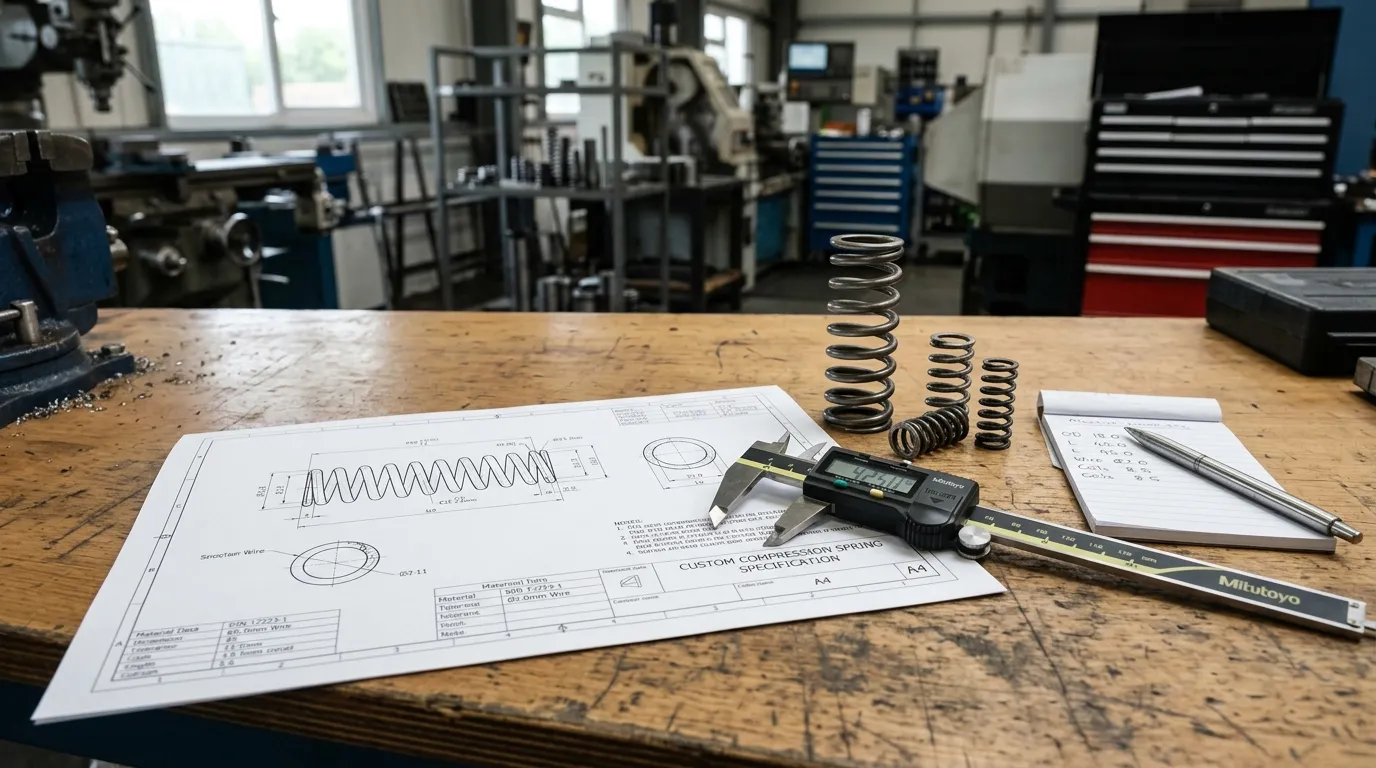
If your project is already moving from a visual guess toward a real tooling decision, review the relevant JIS die spring family and move to custom spring support when the catalog route no longer matches the drawing or installed conditions cleanly.
That is the real difference between a seasonal image and a sourcing task. A seasonal image can inspire attention. A sourcing decision still has to survive installation, production, and maintenance.
Common mistakes when the language stays too loose
Vocabulary problems may look small at the start, but they often create more expensive problems later. When teams keep the language too broad, they increase the chance that different people are solving different problems without realizing it.
Here are some common mistakes:
- Using the word spring without stating whether the project needs a die spring, compression spring, or another spring type.
- Assuming a green spring in one catalog will match a green spring in another system without technical confirmation.
- Relying on image similarity instead of checking the actual standard family and dimensions.
- Letting content or translation teams simplify product naming until the engineering meaning becomes unclear.
- Treating color as the final specification rather than one recognition aid inside a larger product definition.
These mistakes can slow quotations, create preventable back-and-forth, and increase replacement risk later. They also weaken technical content. An article or product page becomes much more useful when it moves from an interesting hook to a precise explanation quickly and confidently.
That matters for global manufacturing websites. The reader may be a tooling engineer, a purchasing manager, a junior sourcing assistant, or a translator supporting an inquiry. Clear terminology helps all of them arrive at the same meaning faster.
How to describe a die spring correctly in an RFQ or product page
If the goal is clarity, the safest approach is to name the spring in full and then add the selection context. A good technical inquiry does not stop at color or a general category word. It identifies the spring family and provides enough detail for a supplier to respond accurately.
A practical RFQ or product description should make the following clear:
- whether the part is specifically a die spring,
- which standard or product family the project is built around,
- what dimensions and installed conditions need to be respected,
- whether the goal is direct replacement or a new design review, and
- whether the team needs a catalog item or a drawing-based custom solution.
This type of wording helps both the buyer and the supplier. It improves quotation speed, reduces ambiguity, and makes later maintenance easier because the project record is more precise from the beginning.
For content teams, the lesson is similar. If a blog title uses the double meaning of spring to attract attention, the body should quickly define the industrial term, explain why the color exists in the catalog, and direct readers toward the correct technical decision. That approach teaches without becoming vague, and it protects the credibility of the article.
Why this distinction matters for sourcing, maintenance, and content accuracy
At first glance, the phrase spring vs die spring may look like a small vocabulary lesson. In practice, it affects how people search, how they translate product pages, how they build RFQs, and how they plan future replacement. That makes it relevant to engineering, procurement, and content operations at the same time.
For sourcing teams, the benefit is straightforward. Precise naming reduces the chance of asking for the wrong part. For maintenance teams, precise naming makes replacement more manageable later. For content teams, precise naming allows a creative concept without sacrificing technical trust. A springtime image can open the conversation, but a die spring article has to end with a clear understanding of what the part is and how it should be selected.
That is why a green JIS die spring is such an effective example. It shows how the same color can communicate two different things depending on context. In nature, it is seasonal. In tooling, it is systematic. The word stays the same, but the meaning changes completely once the application becomes industrial.
Frequently Asked Questions
Does the word “spring” always mean a die spring in industrial English?
No. In industrial English, spring is still a broad category word. It may refer to compression, extension, torsion, or die springs. The surrounding product language determines the exact meaning.
Is every compression spring also a die spring?
No. A die spring belongs to a more specific tooling context. It is related to compression behavior, but it should not be treated as the same thing as any general compression spring without checking the application and product family.
Does green always mean the same thing in every die spring catalog?
No. Color is often used as an identifier within a product system, but the exact meaning should be checked against the supplier’s catalog, drawing, or series data. Do not assume equivalence from color alone.
Can I identify a replacement die spring by color only?
You should not rely on color alone. Confirm the standard family, dimensions, installation requirements, and the intended application before approving a replacement.
When should I move from a standard die spring to a custom solution?
Move to custom review when the catalog spring does not match the installed space, stroke, or application logic cleanly, or when the project is better defined by a drawing or sample than by a standard part name.
Work With Dingli
Cixi Dili Spring Co., Ltd. has focused on spring manufacturing since 1995 and supports both standard and custom production based on samples or drawings. If your team needs help confirming whether a part should stay in a standard die spring path or move to a drawing-based solution, start the discussion through contact us. For direct project support, EMAIL: [email protected] or WhatsApp: +86 13586942004.