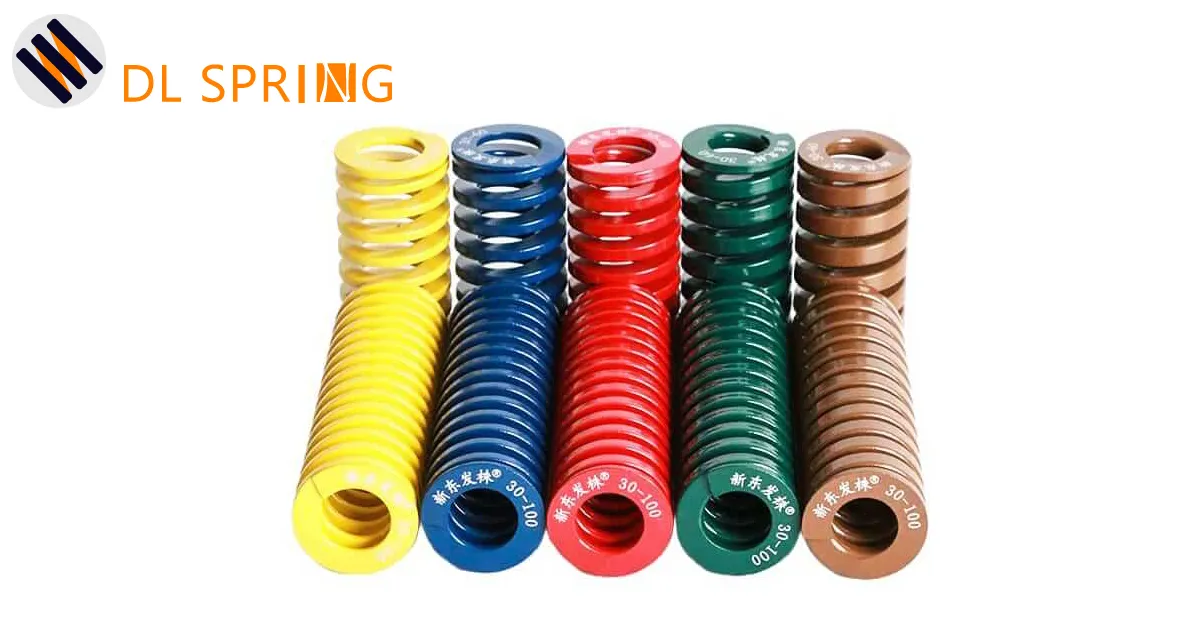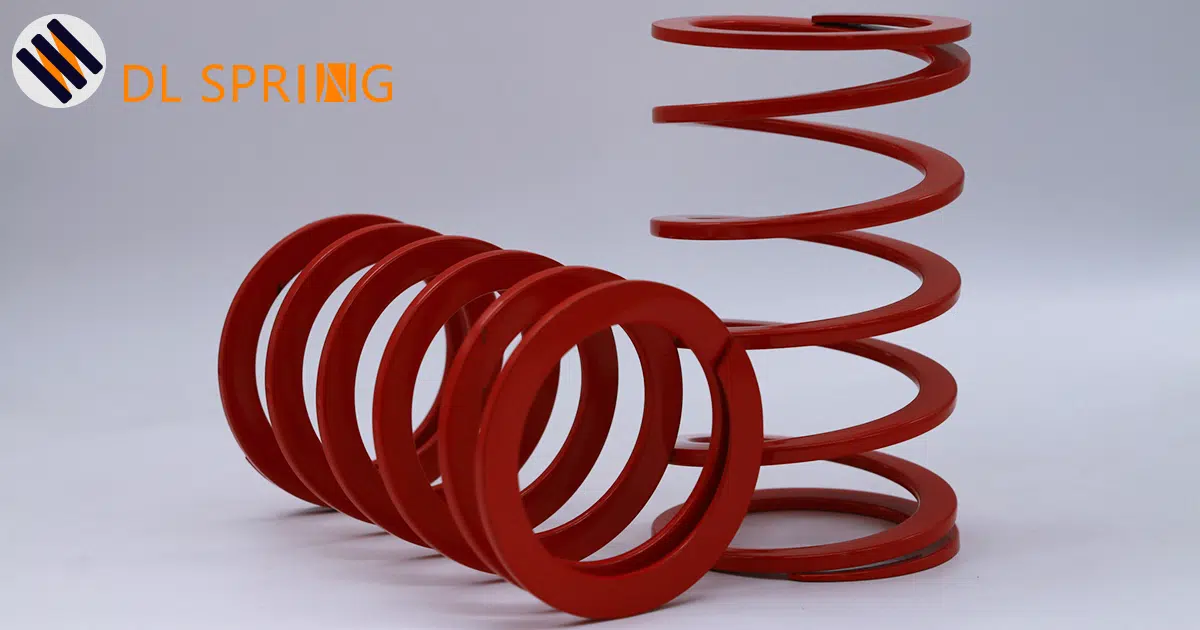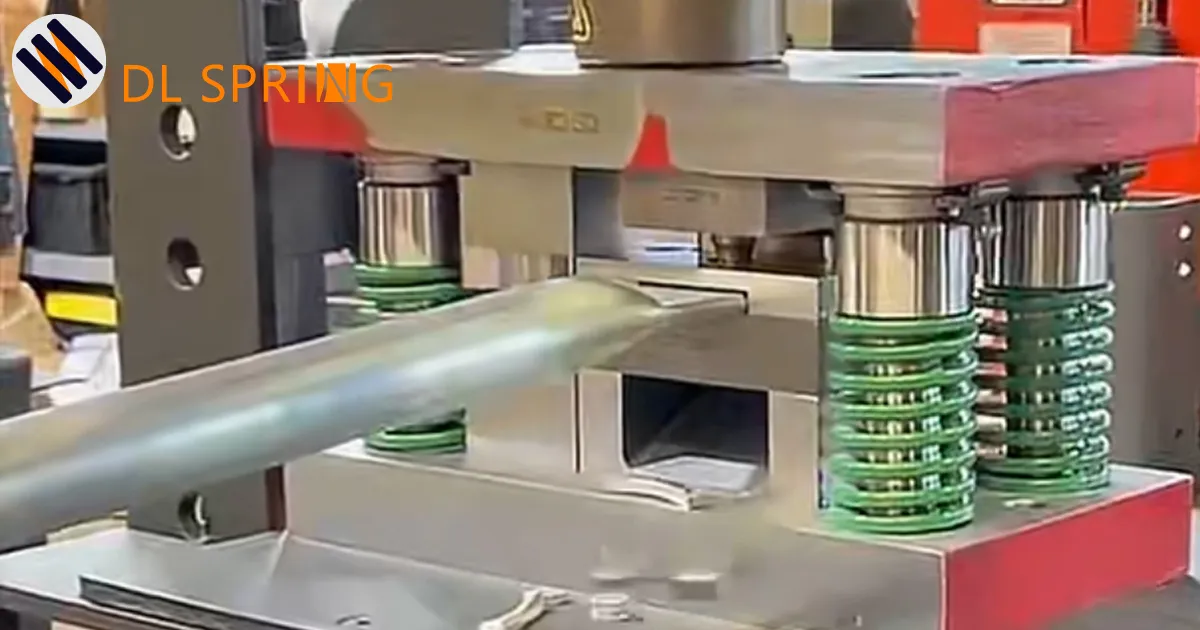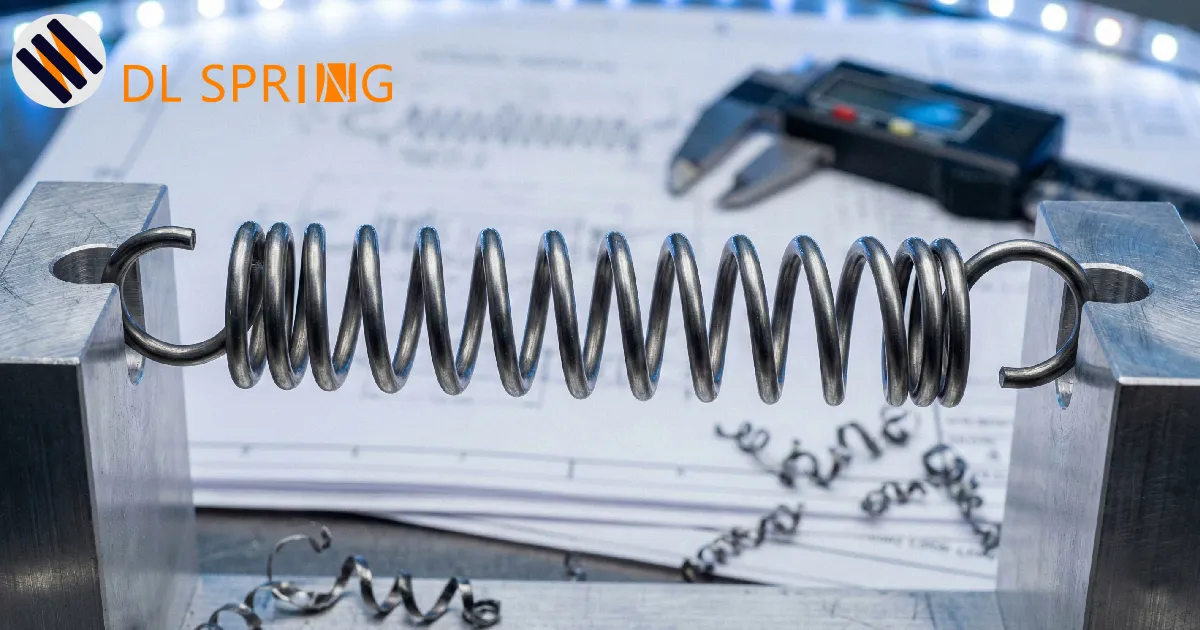
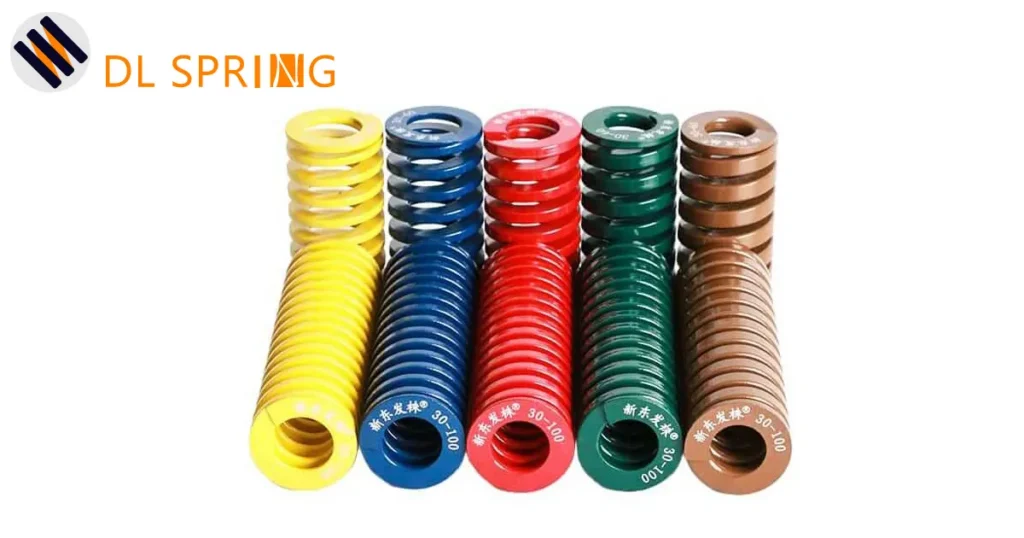
Every time a die set comes back online, the first thing most operators check is the color of the spring, maybe whether there’s oil residue, and then they hit the cycle button. Too often, the first batch ends with a loud “clack,” a stuck punch, or a rejected lot. We lean on color codes and gut feeling, while the real game is being played by material grades, stiffness, heat treatment, and maintenance. This article translates those data points into plain English, with a sharp focus on 65Mn, 50CrVA, and 55CrSi die springs and the lessons Cixi Dili Spring Co., Ltd. has learned on shop floors worldwide.
The Three Core Materials and Where Each One Shines
65Mn
Hardness usually lands in HRC 44–48 after 820 °C quench and 460 °C temper. It’s cost-effective and perfect for medium-tonnage single-stage dies or fixtures, but it’s picky about heat treatment. Overheat it during tempering or compress it beyond the elastic zone in production, and the residual austenite means it relaxes early.
50CrVA
Expect HRC 46–50. Vanadium lifts the elastic limit and impact strength, which is why high-speed or progressive dies love it. It is sensitive to quench rate, so automated oil quench with tight temperature control is essential to prevent internal stress fractures.
55CrSi
HRC 47–52 with excellent anti-relaxation behavior. It thrives in high-load, long-stroke, or hot environments such as large stamping or die-casting tools. The only caveat: heat soak kills it. Always release travel when the die is idle and keep a lubricant film on the coils.
Think of the three grades as footwear: 65Mn is your everyday sneaker, 50CrVA is the game-night shoe, and 55CrSi is the trail boot you wear when failure isn’t an option.
Six Real Metrics That Keep Die Springs Honest
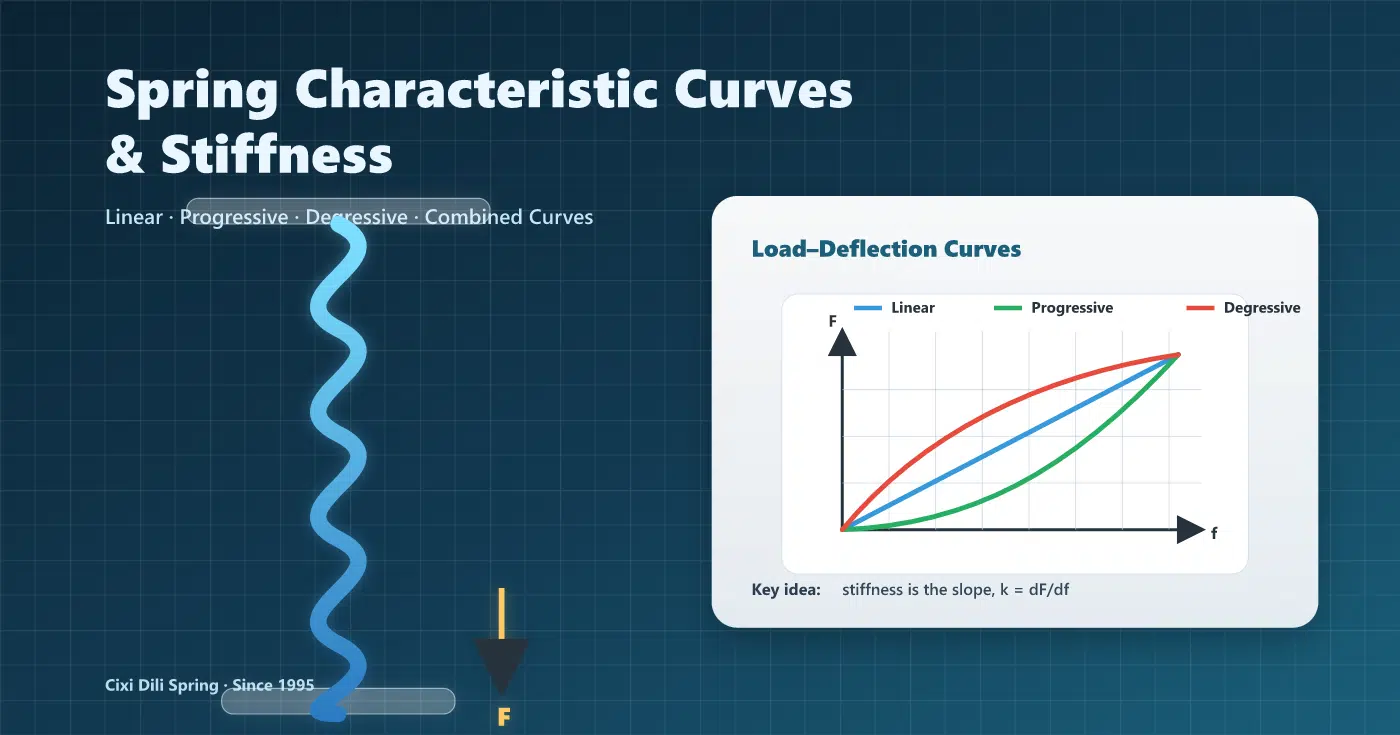
- Stiffness (k = ΔF/Δx). Always plot the die travel against the spring’s force-displacement curve. Keeping the working point within 20–80 % of the linear zone prevents the “gets softer every week” problem.
- Rigidity / Deflection. If the spring doubles as part of a beam, the whole system follows δ = (F·L³)/(3·E·I). Support blocks or shorter spans matter just as much as the spring grade.
- Strength. 65Mn yields around 785 MPa, 50CrVA about 900 MPa, and 55CrSi crosses 1,000 MPa. Multiply by a 1.2–1.5 safety factor, especially inside progressive dies where every overload leaves a permanent scar.
- Hardness. Use Brinell (HB) for bulk sections, Rockwell C (HRC) for most die springs, and Vickers (HV) whenever surface treatments need verification. Quick rule: HRC 48 roughly equals HB 480.
- Elasticity vs. Plasticity. Multi-step tempering plus shot peening can create a “soft landing zone” past the elastic limit, so emergency over-travel absorbs energy instead of snapping the coil.
- Toughness. AKU (impact energy) and KIC (fracture toughness) tell you whether the spring will chip in high-frequency impact. 50CrVA keeps decent AKU even at –20 °C, making it a safe bet for winter stamping lines.
Process Chain: Every Step Matters
The spring winding process at Cixi Dili Spring Co., Ltd. tracks wire diameter, pitch, and tension in real time—vital for tough alloys like 55CrSi. Heat treatment is performed in atmosphere-controlled furnaces with automated loading to keep batch temperature deviations within ±5 °C. Shot peening introduces compressive stress and raises surface HV by 5–10 points, while finishing options (black oxide, phosphating, organic coatings) guard against corrosion. Post-process inspection, detailed on the aftertreatment page, covers NDT, hardness sampling, free height checks, and fatigue testing so each batch leaves the factory inside its design window.
Four Typical Die Scenarios and How to Choose Springs
- Single-operation stamping: short travel, high frequency, quick maintenance. 65Mn works well, but set mechanical stops so the stroke stays within 40 % of maximum compression.
- Progressive dies: long strokes, synchronized springs. 50CrVA’s high elastic limit provides breathing room. Break the die into functional zones and leave ≥15 % load headroom in each zone.
- Plastic molds (return systems): constant temperature plus compression. 55CrSi resists relaxation and makes a solid main return spring; always release the stroke during downtime.
- Die-casting molds: hot, vibrating, and messy. Use phosphated 55CrSi springs and add protective sleeves to keep molten aluminum off the coils.
Mini checklist—replace the spring if: free height drops more than 2 %, operating stroke exceeds 60 % of max compression, the surface shows blue temper marks or cracks, the return feels “two-step,” or hand pressure feels mushy.
Why Die Engineers Keep Coming Back to Cixi Dili Spring Co., Ltd.
- Founded in 1995 with deep experience in automotive, appliance, and consumer-electronics tooling.
- Full portfolio: JIS and US color-coded die springs, compression, extension, torsion, music wire, and custom-shaped parts—shipped worldwide.
- Complete in-house chain from winding through heat treatment, shot peening, and final inspection, all compliant with JIS, DIN, ANSI, ISO, and GB standards.
- Fast customization: upload drawings or specs via the custom spring request form, and the engineering team replies with force curves, material proposals, and lead time.
- Transparent resources: explore the product catalog, learn about the company on About Dingli, or reach the team via the contact page.
Wrap-up: Put the Material Grade in the BOM and Give Yourself Some Peace
Stop treating spring replacement as a firefight. Document where 65Mn, 50CrVA, and 55CrSi belong; record force-stroke data; and your die set will finally behave. Cixi Dili Spring Co., Ltd. captures those numbers so you can make decisions by data, not guesswork. Take one afternoon to audit your current springs: which ones are overdue for retirement, and which can be standardized? Once the data is in place, the die—and your production schedule—will calm down.
FAQ
- What’s the temperature ceiling for 65Mn vs. 50CrVA?
65Mn starts relaxing above 120 °C, while 50CrVA can tolerate roughly 150 °C thanks to vanadium. If your die lives in a hot zone, lean toward 50CrVA or 55CrSi. - How do I estimate die spring life?
Convert working travel into strain, compare it to the material’s fatigue limit with a 1.2–1.5 safety factor, and cross-check the press stroke rate. Dingli provides force-travel-life cubes so you can look up the expected cycles. - Does shot peening really change hardness?
Yes, surface HV typically rises 5–10 points, but the real win is compressive residual stress, which boosts fatigue life. Inspect the peened layer periodically and rework it if wear shows. - How should I store springs during long downtime?
Release the stroke, remove or block the springs open, coat them with rust inhibitor, and store them in a dry cabinet. 65Mn is particularly humidity-sensitive. - What data should I send before ordering?
Free height, outer/inner diameter, wire diameter, active coils, target load, working travel, available space, and operating temperature. If you can share the actual load curve, Dingli can respond even faster.
Contact
📧 Email: [email protected]
📱 WhatsApp: +86 13586942004