By Cixi Dili Spring Co., Ltd. | Engineering Team
I’ve seen it happen a dozen times. An engineer spends weeks designing a complex assembly, calculating every load path and tolerance, only to have the entire system fail during validation because of a $2 part: the extension spring.
It’s frustrating because, on paper, extension springs look deceptively simple. You pull them, they stretch, they pull back. But in reality? They are arguably the most difficult spring to manufacture with high consistency. A standard catalog spring might look right, but it often lacks the engineering nuance to survive real-world fatigue.
At Cixi Dili Spring Co., Ltd., we’ve been tackling these challenges since 1995. We don’t just coil wire; we manage the complex internal stresses that make or break your product. Today, I want to take you onto the factory floor and explain what actually happens to your springs under load—and why “off-the-shelf” is often a gamble you shouldn’t take.
The “Black Box” of Initial Tension (F_i)
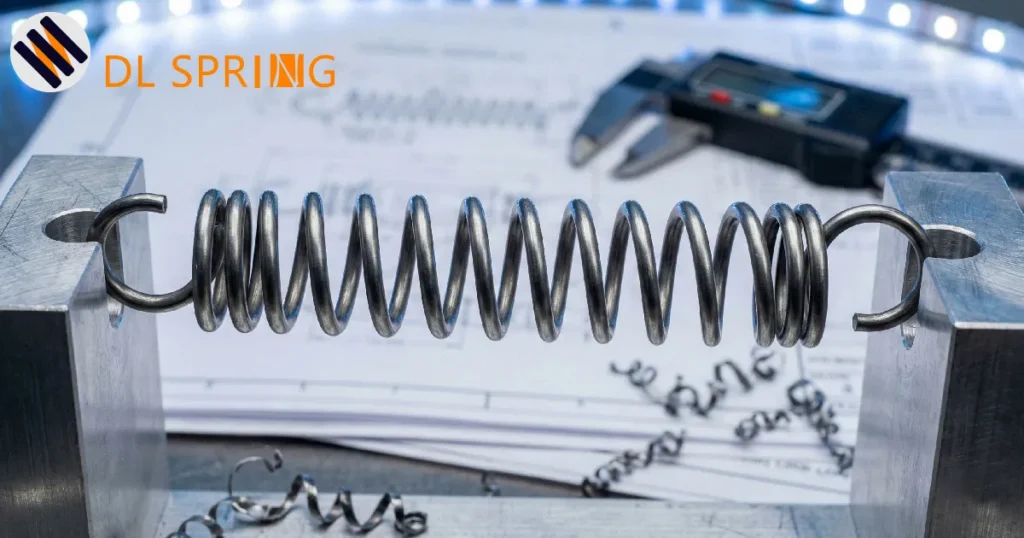
Here is something many procurement managers don’t realize: unlike compression springs, most extension springs carry a hidden internal force before you even touch them. This is Initial Tension (F_i).
It’s the force that keeps the coils locked tightly together. If you’ve ever tried to pry apart a stiff extension spring, you’ve felt it.
It’s Not Just Math, It’s an Art Form
Creating consistent initial tension is one of the hardest tasks in spring manufacturing. We create it by “back-winding” the wire—literally twisting it against the direction of the coil as it feeds into the machine. It’s a delicate balance.
Field Note: We often see variation in initial tension because of subtle differences in the raw wire’s tensile strength. Even within the same batch of Music Wire, properties can fluctuate. That’s why our technicians at Cixi Dili don’t just set the CNC machine and walk away; they perform real-time load testing during the run to adjust for these material quirks.
The Weakest Link: A Real-World Failure Story
Let’s talk about where things break. In the spring industry, we have a saying: “If it fails, check the hook.”
A few years ago, we had a client in the industrial tooling sector come to us. They were using a standard “Machine Hook” extension spring from a general distributor. Their springs were snapping right at the neck—the transition point where the coil body turns up to form the loop—after only 10,000 cycles. They were baffled because the load was well within the theoretical limits.
The Culprit: Stress Concentration
The problem wasn’t the load; it was the geometry. The previous manufacturer had used a sharp bend radius to form the hook. In engineering terms, this skyrocketed the Stress Concentration Factor (K). The stress at that tiny bend was nearly double what they calculated for the body of the spring.
The Fix: We redesigned the spring using a tapered transition and a larger bend radius. We also added a specialized post-forming stress relief cycle. The result? The new springs passed 200,000 cycles without a single failure. It wasn’t magic; it was just better stress management.
The Silent Killer: Hydrogen Embrittlement
If there is one thing that keeps me up at night regarding quality control, it’s Hydrogen Embrittlement.
When you plate a high-carbon spring (like Music Wire) with Zinc or Nickel to prevent rust, you introduce atomic hydrogen into the steel. If that hydrogen isn’t baked out immediately, it makes the steel brittle.
I cannot stress this enough: this failure is invisible. The spring looks perfect. It passes the load test. But a week later, while sitting on a shelf under tension, it snaps spontaneously.
At Cixi Dili, we are obsessive about this. If a high-tensile spring gets plated, it goes into the baking oven immediately. We don’t wait for the next shift. We don’t wait for the oven to fill up. We bake it to drive that hydrogen out. Many budget suppliers skip this step to save electricity. Is it worth the risk?
Precision Manufacturing: When 0.01mm Matters
You might have seen the formula for Spring Rate ($k$):
k ≈ (G * d⁴) / (8 * N * D³)
Look at that little number 4 next to the wire diameter ($d$). That means the wire diameter is raised to the fourth power.
In plain English? A tiny error in wire size creates a huge error in force.
If the wire is just 1% thicker, the spring becomes 4% stiffer. If the coil diameter varies slightly, the rate swings wildly the other way. This is why “close enough” doesn’t work in our industry. We use automated sorting and high-precision CNC formers to ensure that the spring we send you matches the physics of your design, not just the picture in the catalog.
Beyond Standard: Custom Solutions
Sometimes, standard cylinders just don’t fit. We often engineer Custom-shaped Springs to navigate tight spaces. We’ve built springs with:
- Extended hooks to reach deep into assemblies.
- Conical bodies to telescope down and save solid height.
- Off-center loops to align force vectors perfectly.
Let’s Engineer a Solution Together
An extension spring isn’t just a piece of twisted wire; it’s an energy storage device that needs to be respected. Whether you are dealing with early fatigue failures, inconsistent loads, or just need a partner who understands standards (JIS, DIN, ISO, ANSI), we are here to help.
At Cixi Dili Spring Co., Ltd., we combine 30 years of manufacturing grit with modern engineering standards.
Don’t guess on your next design. Let’s verify it.
Contact Our Engineering Team
Send us your drawings, your samples, or even just a sketch on a napkin. We’ll handle the rest.
Email: [email protected]
WhatsApp: +86 13586942004
FAQ: Common Questions from the Factory Floor
Q: Why did my spring “relax” and get longer over time?
A: That’s likely stress relaxation. If you stretch the spring too close to its elastic limit, or if it gets hot, the steel grains realign, and you lose initial tension. We can fix this by changing materials or “pre-setting” the spring during production.
Q: Can you make hooks that swivel?
A: Absolutely. For applications where the spring rotates (like in some throttle assemblies), a fixed hook will break. We can install swivel inserts or design floating hooks to eliminate that torsional stress.
Q: I need a spring tomorrow. Do you have stock?
A: We do stock standard Die Springs, but for specific extension springs, “stock” is rarely the right answer. However, our rapid prototyping team can often turn around samples in days, not weeks.