Large Pitch Rectangular Wire Die
Most die springs you’ll find have fairly consistent pitch-to-diameter ratios. But what happens when your application needs something different—when you need a spring that can compress significantly more than standard configurations allow?
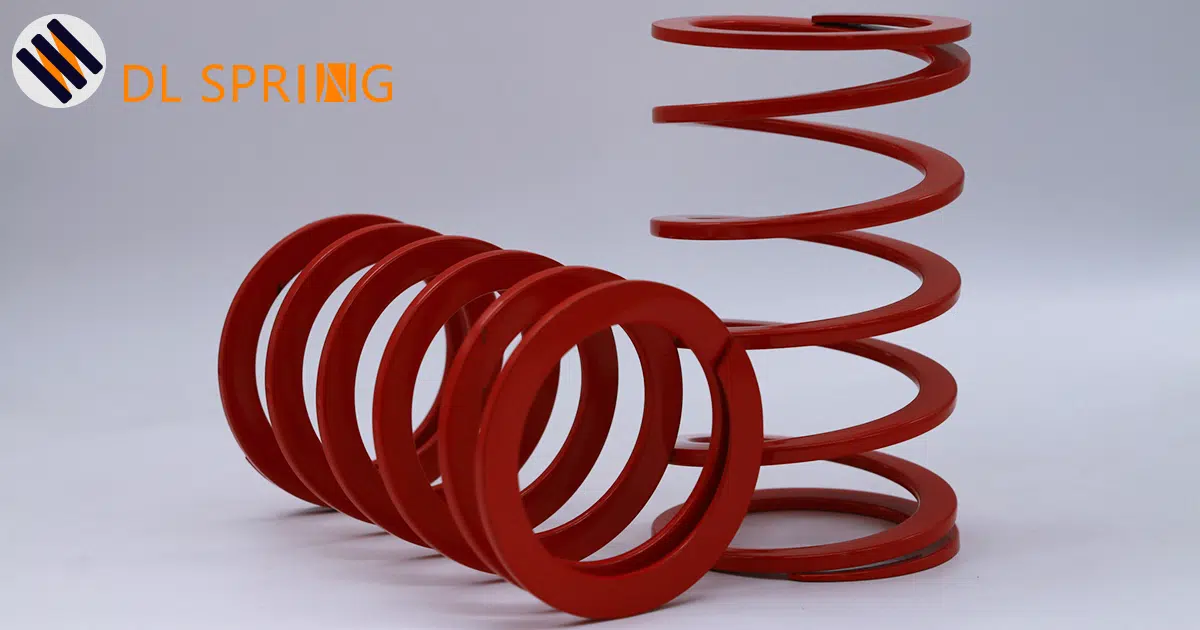
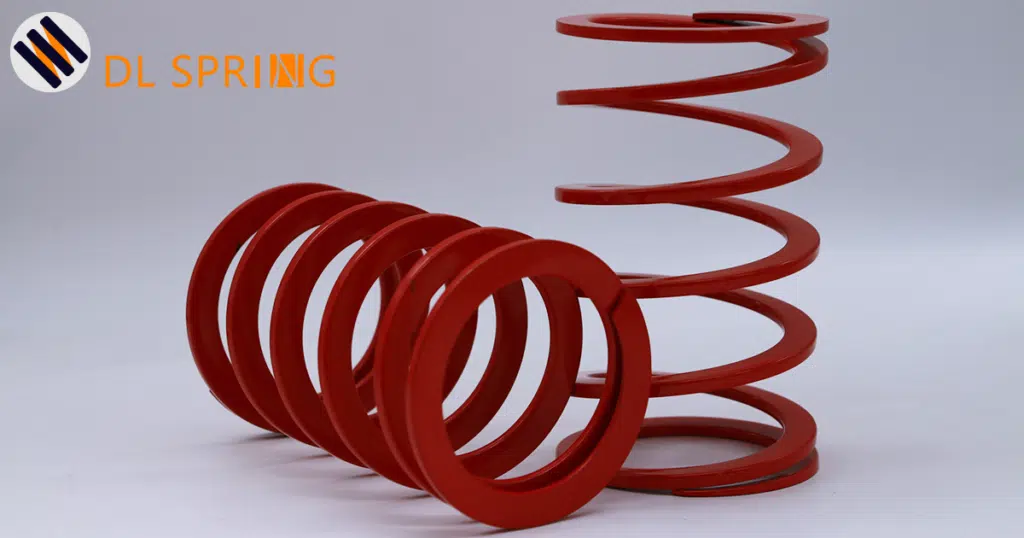
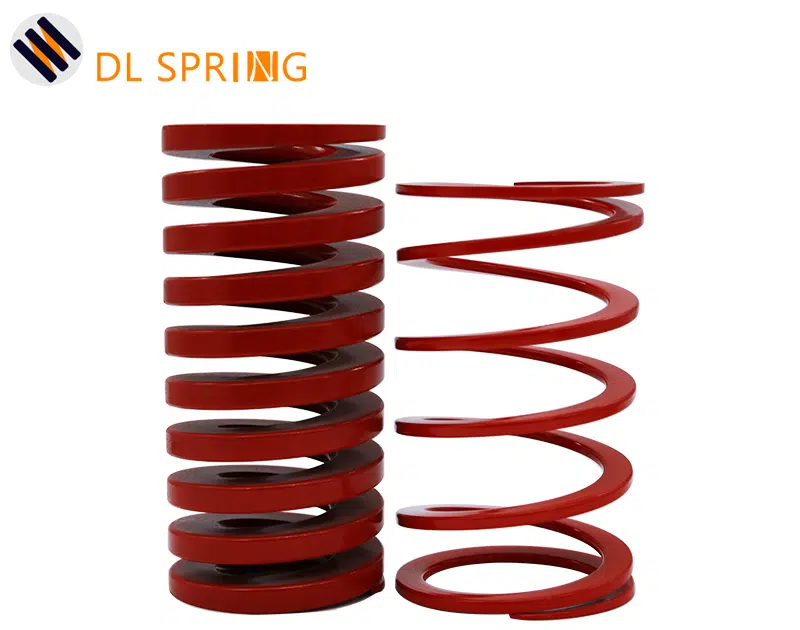
That’s exactly the kind of challenge we tackle at DL Spring. The red rectangular wire springs you see below represent a design that many spring manufacturers would consider difficult to produce: a large pitch compression spring with a compression ratio that goes well beyond typical die spring specifications.
The Challenge of Large Pitch Springs
Here’s something most engineers discover when they start specifying compression springs: when the pitch of a spring is greater than the outer diameter, it creates coiling difficulties. The wire wants to buckle, the coils can become uneven, and maintaining consistent spring characteristics becomes challenging.
With our spring here, the working travel goes from 110mm free length down to 52.5mm at the second working position—that’s 57.5mm of compression. For a spring with just 4.75 active coils, that’s significant travel per coil.
Why Use Rectangular Wire?
You might ask why we used rectangular wire instead of round wire for this application. The answer comes down to solid height.
When this spring compresses, the rectangular cross-section allows the coils to nest more efficiently than round wire would. This means we can achieve the required compression travel without the spring going solid prematurely. It’s a design choice driven by the specific requirements of the application.
Material Selection: 55CrSi Spring Steel
We manufacture these springs from 55CrSi steel, known in the JIS standard as SUP 12. If you’re more familiar with international designations, it’s equivalent to ASTM 9254 or SAE 9254.
According to material specifications, 55CrSi has a chemical composition of approximately 0.56-0.6% carbon, 1.20-1.60% silicon, and 0.5-0.8% chromium. The high silicon content is what gives this material its excellent elastic properties and fatigue resistance.
What matters practically? This material maintains its spring characteristics well under repeated cycling and has good relaxation resistance—meaning it won’t lose height as quickly over its service life compared to lower-grade spring steels.
Why Not Use Standard Music Wire?
For applications where the spring will see elevated temperatures or high stress cycles, 55CrSi offers better performance than basic high-carbon spring wire. The silicon and chromium additions improve the material’s ability to resist permanent set under load.
Red Electrophoretic Coating: More Than Just Color
The distinctive red finish on these springs isn’t powder coating—it’s electrophoretic coating, also called e-coating or cathodic electrodeposition.
According to e-coating process information, this method involves immersing the spring in a water-based paint solution and using electrical current to deposit a uniform coating on the metal surface. The coating thickness is typically 10-30 microns.
Advantages for These Springs
Why e-coating instead of powder coating or zinc plating?
- Uniform coverage: E-coating reaches into the tight spaces between coils better than powder coating, which is important for springs with close coil spacing at certain compression levels
- Thin coating: The coating is thin enough that it doesn’t significantly affect the spring’s dimensional tolerances
- Corrosion resistance: Provides good protection in industrial environments
- Visual identification: The red color makes these springs easy to identify during assembly and maintenance
Our surface treatment process ensures consistent coating quality across production batches.
Custom Spring Design: How We Approach It
Here’s how a project like this typically works when a customer comes to us with a challenging requirement.
Step 1: Understanding the Application
We don’t just ask for a spring rate and dimensions. We want to know:
- What forces are needed at what compression distances?
- How much space is available for installation?
- What’s the expected cycle life?
- Are there temperature considerations?
- How will the spring be guided (if at all)?
Step 2: Force Calculation and Verification
This is where our design team adds value. Looking at the spring in the photos, you can see it operates at two working positions: 90.5mm and 52.5mm.
With a spring rate of 9 N/mm, we can calculate the forces:
At Working Position 1 (90.5mm):
Compression from free length = 110 – 90.5 = 19.5mm
Force = 9 N/mm × 19.5mm = 175.5 N
At Working Position 2 (52.5mm):
Compression from free length = 110 – 52.5 = 57.5mm
Force = 9 N/mm × 57.5mm = 517.5 N
But here’s the important part: we don’t just calculate what the spring will do—we verify that these forces match what the application actually needs. Sometimes a customer thinks they need one spring rate, but when we review their application requirements, we find a different specification would work better.
Step 3: Manufacturability Review
Can we actually make what’s been designed? With large pitch springs, this is a real question.
Our spring winding equipment can handle rectangular wire coiling, but there are limits. The spring index, pitch-to-diameter ratio, and material properties all factor into whether a design is feasible to manufacture consistently.
For this particular spring, the rectangular wire cross-section needed to be selected to provide the right spring rate while being manufacturable on our equipment. It’s a balance.
Step 4: Prototype and Testing
For custom springs, we typically produce prototype samples first. These get tested to verify:
- Spring rate matches calculations (within tolerance)
- Dimensions are correct
- The spring behaves as expected through its full compression range
- No buckling or instability issues
Only after prototype approval do we move to production quantities.
When Do You Need This Type of Spring?
Large pitch rectangular wire springs aren’t common, and they’re not the right solution for every application. But they make sense when:
You Have Limited Vertical Space
If your equipment has a restricted shut height or installation depth, but you still need significant compression travel, increasing the pitch while using rectangular wire can be a solution.
You Need Variable Force Through a Long Stroke
When your application requires relatively light forces at one position and heavier forces at another position, but both positions are far apart, a spring like this can work well.
Standard Die Springs Don’t Fit Your Requirements
Sometimes you look through standard die spring catalogs and nothing quite fits. That’s when custom design makes sense.
Design Considerations and Limitations
I should be honest about the limitations of this type of spring design.
Guidance Requirements
A spring with large pitch relative to its diameter is more prone to buckling under compression. For the spring shown here to work properly, it needs adequate guidance—either a center rod, an outer tube, or both.
Without proper guidance, the spring could deflect laterally when compressed, which would change its force characteristics and potentially cause premature failure.
Manufacturing Tolerances
Large pitch springs can have wider tolerances on some dimensions compared to standard pitch springs. The spring rate tolerance, for example, might be ±10% rather than the ±5% you might get with a standard compression spring.
This doesn’t mean the spring won’t work—it just means you need to design your application to accommodate this variability.
Cost Considerations
Custom springs cost more than standard catalog springs. There’s tooling to set up, prototypes to make, and potentially lower production efficiency due to the specialized nature of the design.
But if a custom spring solves a design problem that would otherwise require expensive modifications to your equipment or tooling, the cost equation often works out favorably.
Our Manufacturing Capabilities
What can we actually do in our facility? Here’s a realistic overview.
Rectangular Wire Range
We work with rectangular wire in various cross-sections. The specific dimensions depend on material availability and our tooling capabilities. Not every conceivable wire size is available, so sometimes we need to select from standard wire dimensions and adjust the design accordingly.
Spring Dimensions
For compression springs like the one shown:
- Outer diameters from about 15mm up to 150mm
- Free lengths from 20mm to 400mm+
- Spring rates from very light (under 1 N/mm) to heavy (several hundred N/mm)
These are general ranges—specific capabilities depend on the combination of parameters.
Surface Treatment Options
Beyond the red e-coating shown here, we offer:
- Other e-coating colors
- Zinc plating
- Phosphate coating
- Uncoated (oil-coated for rust prevention)
The choice depends on your environmental requirements and preferences.
Working With Us: The Process
If you have a spring application that standard products don’t solve, here’s what working with us looks like.
Initial Consultation
Send us your requirements. This can be:
- A drawing with dimensions and force requirements
- A sample spring that’s close to what you need
- A description of your application with the constraints you’re working within
Our engineering team will review and provide feedback on feasibility.
Design and Quotation
We’ll propose a spring design (or potentially a few options) with:
- Detailed specifications
- Expected force characteristics
- Pricing for prototype and production quantities
- Lead time estimates
Prototype Production
Once you approve a design, we produce prototypes—usually 5-10 pieces depending on the application. This gives you springs to test in your actual equipment.
Production
After prototype approval, we move to production quantities. Typical minimum order quantities for custom springs are 100-500 pieces, depending on complexity.
Common Questions
Can you match a spring from another supplier?
Often, yes. If you send us a sample, we can measure it and provide a matching design. Sometimes we can improve on the original design based on our manufacturing capabilities.
How long does custom spring development take?
Realistically, from initial contact to prototype delivery is usually 2-4 weeks. Production orders take another 3-4 weeks after prototype approval, depending on quantity and material availability.
Do you work from drawings in different standards?
Yes. We work with JIS standards primarily, but we also understand ANSI/US standards, ISO, and DIN standards. As long as the drawing is clear, we can work from it.
What if I don’t know exactly what spring I need?
That’s fine—that’s where our design assistance helps. Tell us what you’re trying to accomplish, what forces you need, what space you have available, and we can propose solutions.
Why This Matters
The springs in these photos represent something important: the ability to solve problems that don’t have off-the-shelf solutions.
Not every spring manufacturer wants to deal with custom designs. Not every manufacturer has the engineering capability to properly calculate forces and verify designs. And not every manufacturer has the production flexibility to make specialized springs economically in reasonable quantities.
We’ve been doing this since 1995—long enough to have seen a lot of challenging applications and developed the processes to handle them effectively.
If you’re working on a project where standard springs aren’t quite right, or you need someone to verify that your spring design will actually work as intended, that’s what we’re here for.
About DL Spring
Cixi Dili Spring Co., Ltd. has been manufacturing springs since 1995. We specialize in custom spring design and production, with particular expertise in die springs, compression springs, and specialized configurations that standard catalogs don’t cover.
Our facility in Cixi, Zhejiang Province includes CNC spring winding equipment, heat treatment systems, and surface treatment capabilities. We primarily serve industrial customers who need reliable springs for demanding applications—die and mold makers, machinery manufacturers, and equipment builders.
We work to JIS standards but can accommodate other international standards as needed. Quality control is integrated into our production process, not just an inspection step at the end.
Get In Touch
If you have a spring application you’d like to discuss:
📧 Email: [email protected]
📱 WhatsApp: +86 13586942004
We can review your requirements and let you know if we can help—usually within 24 hours.