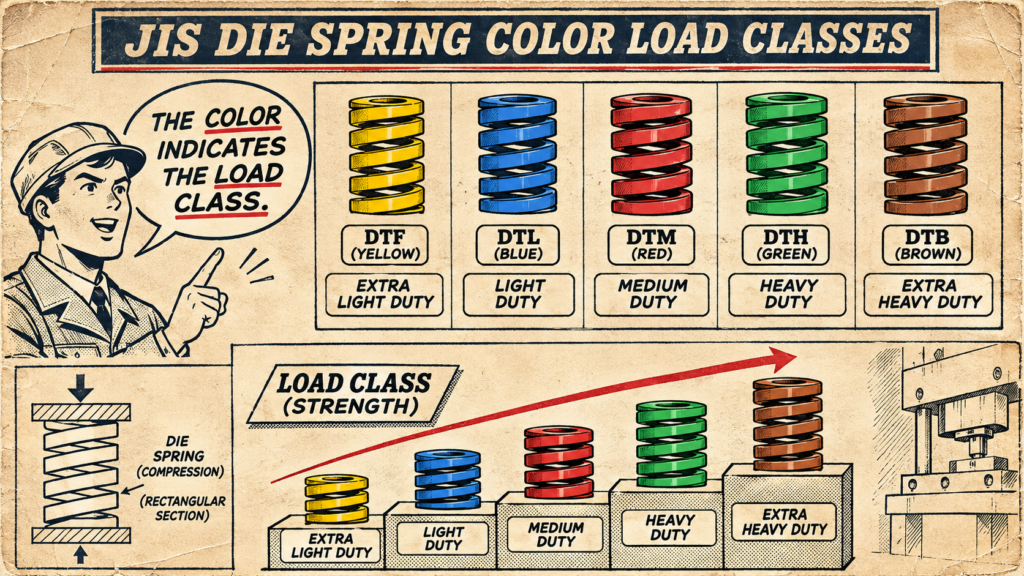
Two yellow die springs can fit the same bore yet produce different forces at the same compressed distance. For a buyer replacing a spring, that is the limit of ordering by color: yellow identifies a load class in a particular catalogue, but it does not specify a force in newtons.
This guide explains the five colors used in Dingli’s JIS-style range, how to read nominal spring rate, and why preload belongs in the calculation. The aim is a purchase specification that identifies the required part and its working conditions clearly.
Read the five colors in their catalogue context
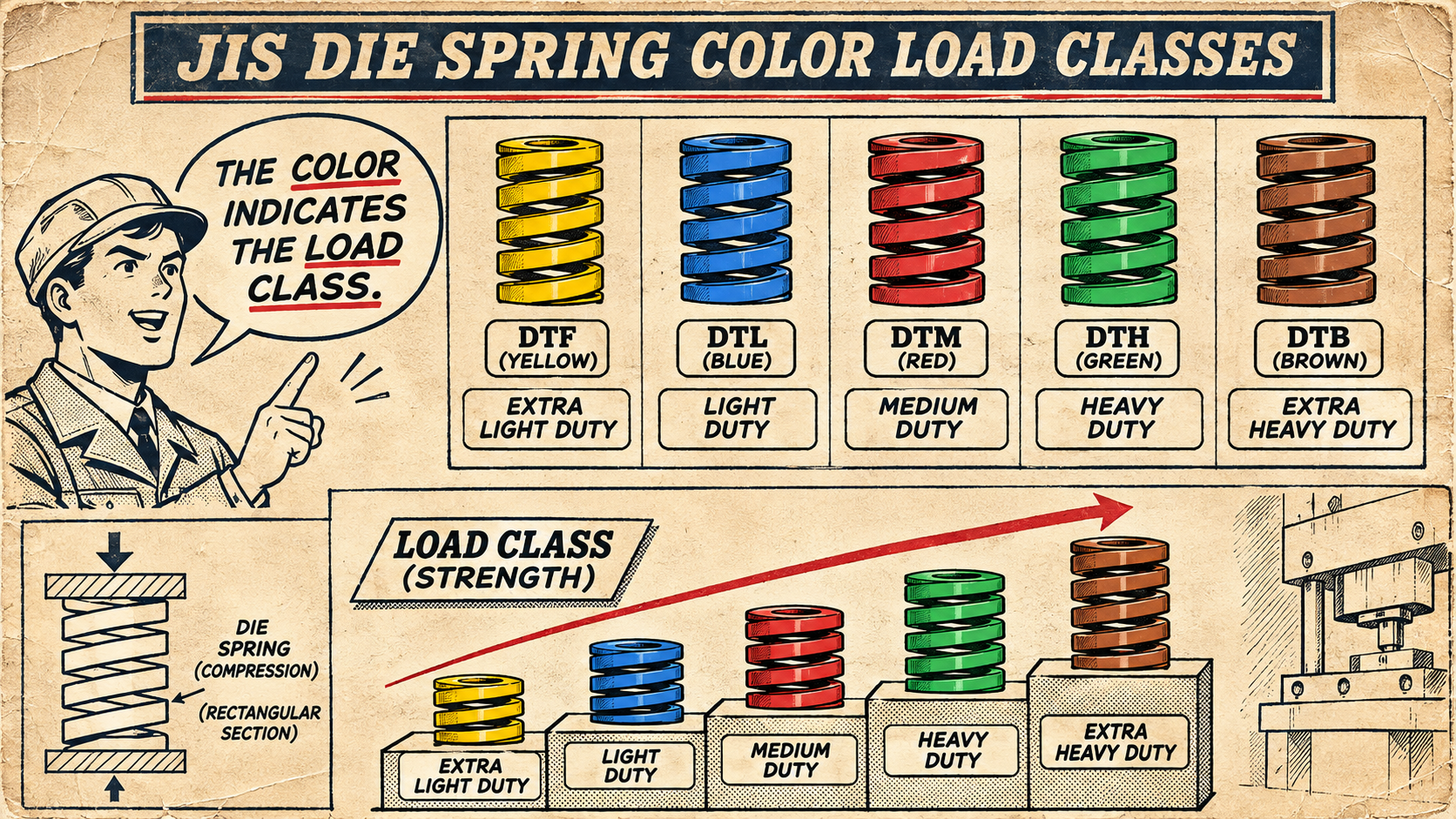
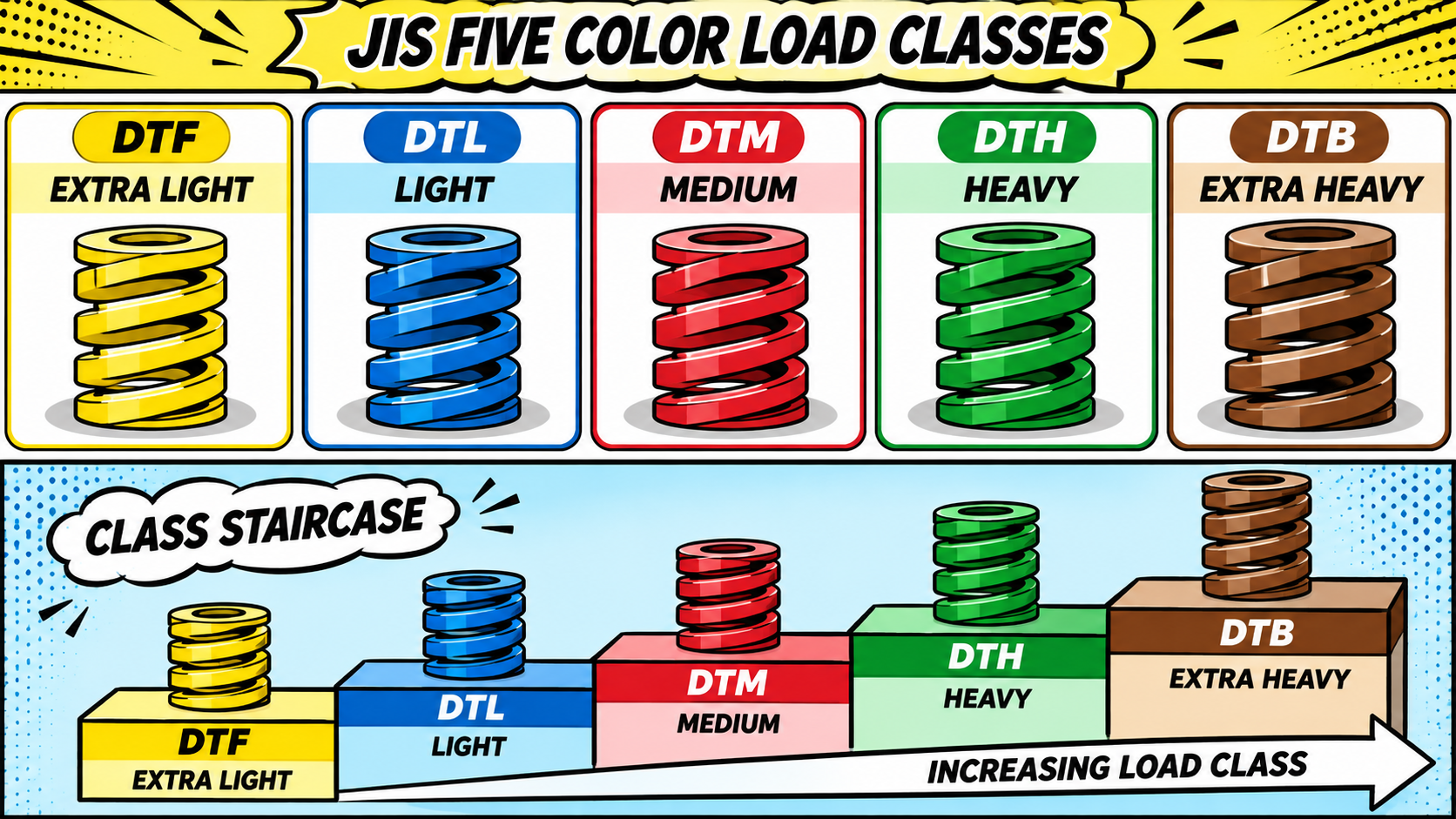
| Dingli series | Identification color | Load class |
|---|---|---|
| DTF | Yellow | Extra light |
| DTL | Blue | Light |
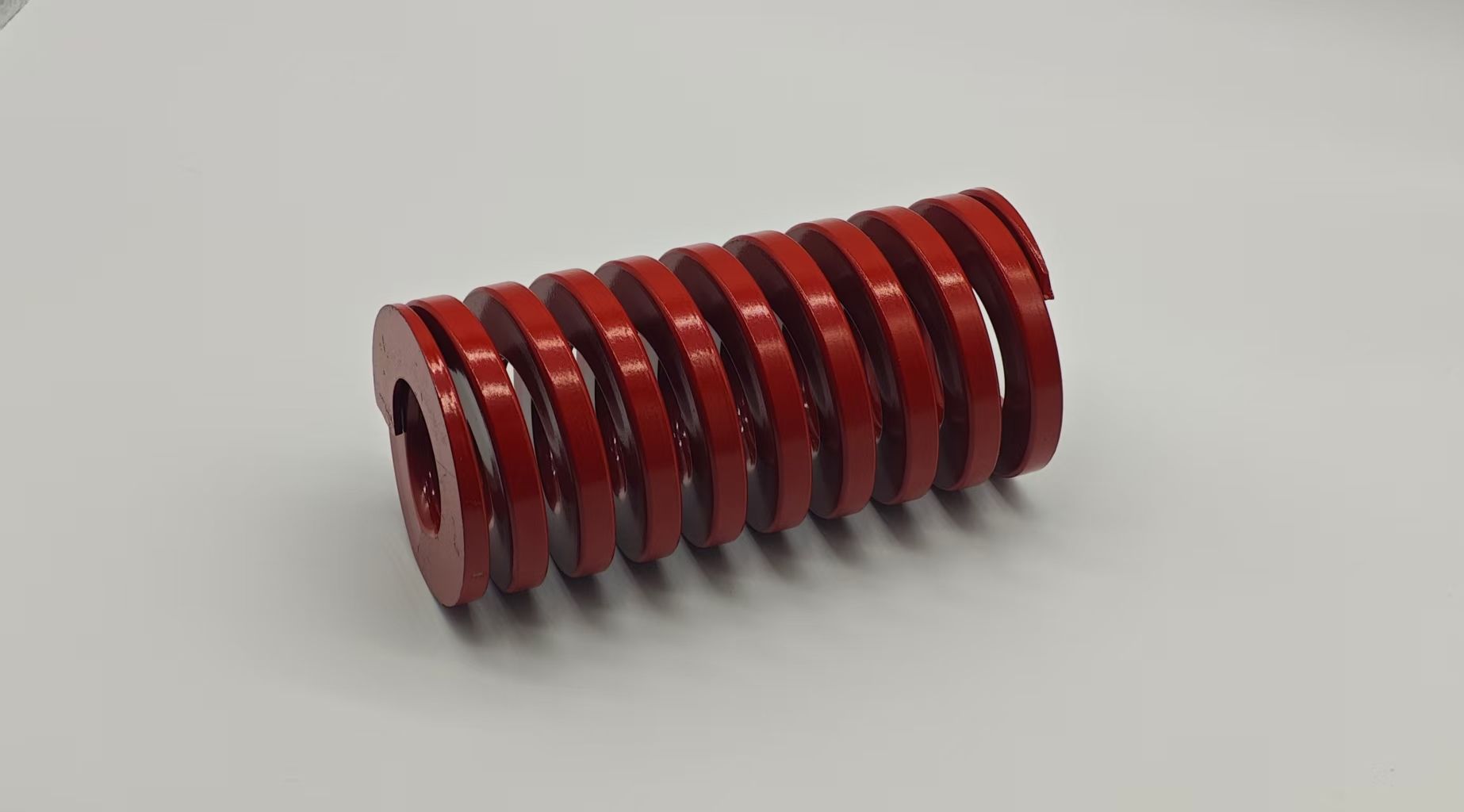
| DTM | Red | Medium |
| DTH | Green | Heavy |
| DTB | Brown | Extra heavy |
This sequence is a common manufacturer convention for JIS-style die springs, also shown in the Dayton Lamina JIS catalogue section. DTF, DTL, DTM, DTH and DTB are Dingli’s series codes, rather than universal standard designations.
Keep the distinction between a catalogue convention and a standards requirement. Table 1 in the JSA preview of JIS B 5012:2008 leaves identification colors unspecified for the JIS-type FJ through BJ entries. It separately lists an ISO 10243 color scheme. The five-color chart above therefore describes this product range; it is not evidence that every spring bearing a JIS reference must use it.
Same color does not mean the same force
Consider two yellow entries in Dingli’s main-site die spring parameter table, checked on November 16, 2026. Both have a nominal outside diameter of 8 mm, but their free lengths and nominal rates differ:
| Part | Free length | Nominal rate k | Hypothetical total deflection x | Estimated force k × x |
|---|---|---|---|---|
| DTF8-20, yellow | 20 mm | 7.8 N/mm | 8 mm | 62.4 N |
| DTF8-40, yellow | 40 mm | 3.9 N/mm | 8 mm | 31.2 N |
At the same assumed absolute deflection, the nominal estimate differs by a factor of two. The deflection ratios also differ: 8 mm is 40% of 20 mm but 20% of 40 mm. This is not a comparison at equal compression percentage.
These are arithmetic examples using published nominal rates, not measured sample results or fatigue-life guarantees. They do not establish an approved working limit. Confirm the current part data, permitted operating range and required force tolerance before selection.
Use spring rate to connect force and compressed height
For an approximately linear compression spring, nominal force can be estimated as F ≈ k × x, where F is force in newtons, k is rate in newtons per millimetre, and x is compression from free length in millimetres. A rate of 7.8 N/mm describes the nominal force change per millimetre of compression; it does not mean the spring always delivers 7.8 N.
Specify acceptance loads at defined test heights. A real load curve can depart from a straight line, particularly near initial seating or near solid height, as explained in Newcomb Spring’s SMI-attributed guidance on compression spring loads. Use the supplier’s applicable curve or agreed test results when nominal arithmetic is insufficient.
When comparing quotations, request force at the same installed and working heights. A single load without its test height is incomplete, while a quoted rate alone does not show whether the spring meets the required loads throughout the stroke.
Include preload in total deflection
A spring usually starts its working movement after installation has already compressed it. Separate the following dimensions, using the same units and measurement references:
- L0: free length before installation.
- Li: installed height at the start of the working stroke.
- Lmin: minimum height reached during operation.
Preload deflection is L0 − Li. Additional working travel is Li − Lmin. Maximum total deflection is L0 − Lmin, which equals preload deflection plus working travel.
With a constant nominal rate, the corresponding estimates are Fstart ≈ k × (L0 − Li) and Fend ≈ k × (L0 − Lmin). Multiplying rate by working travel alone gives the estimated change in force, not the final force.
If a deflection percentage is specified, state its reference: total deflection divided by free length is (L0 − Lmin) ÷ L0. Do not transfer a percentage from a different series or treat it as a general life rating. Our die spring color and compression guide provides related selection context.
Use the comic flow as an identification aid
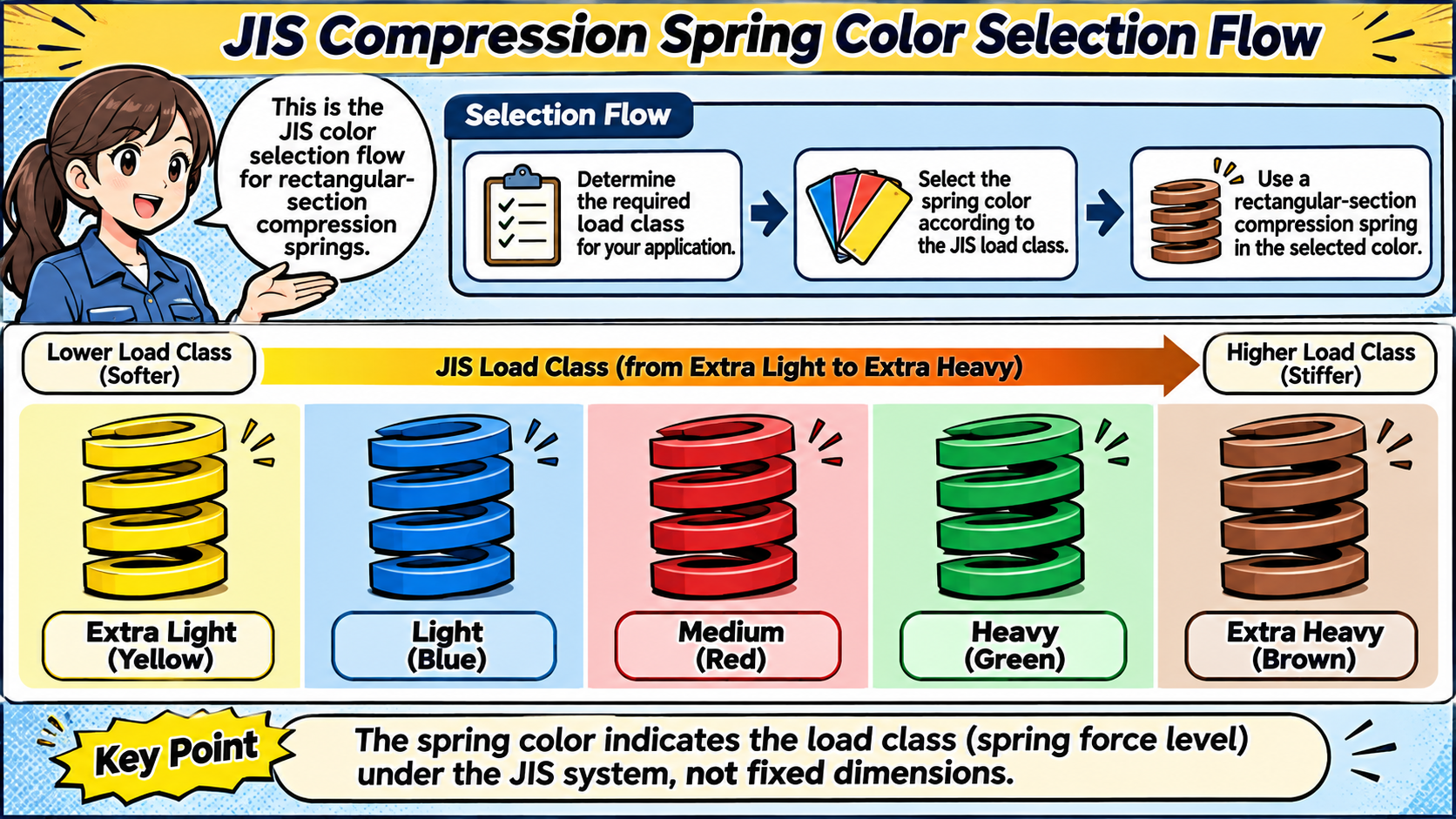
The class–color–size sequence helps a team communicate a catalogue choice. Actual selection also needs the available space, required forces, installed heights and service conditions. Those checks may send the designer back to a different length, size or class.
For an existing spring, start with the recorded manufacturer, series and part number. For a new application, begin with the installation envelope and force requirements, then evaluate candidate parts. Neither route can be completed by choosing a paint color first.
Check the replacement before ordering
Use color to narrow the search, then record the information that makes the part reviewable:
- Identity: manufacturer, exact series, catalogue revision and complete part number.
- Fit: free length, spring diameters, housing bore, guide rod and available installed space.
- Loads: required force and tolerance at the start and end heights, with the additional working stroke stated separately.
- Operating limits: supplier-approved deflection range, clearance from solid height, guidance and installation requirements.
- Service conditions: operating frequency, intended duty, temperature and environment relevant to the application.
- Verification: agreed sample checks, test heights and acceptance criteria before a substitution is released.
A green spring is not automatically a suitable upgrade for a blue spring. Even if outside diameter and free length match, confirm the actual rates, load curves and permitted movement in the selected series. Changing supplier or product family requires the same review.
Color also does not establish steel grade, heat treatment, dimensional conformity or a guaranteed cycle count. Keep those requirements in the drawing or purchase specification. If the existing part cannot be identified reliably, send its records and measurements for review rather than assigning a class from faded paint. Dingli’s spring product range is a starting point for a technical enquiry.
Frequently asked questions
What do the five colors in Dingli’s JIS-style range mean?
Yellow identifies extra light, blue light, red medium, green heavy and brown extra heavy. These are catalogue load classes, not fixed force values or universal material codes.
Can two yellow die springs produce different forces?
Yes. Read the exact part’s rate and compressed position. The yellow DTF8-20 and DTF8-40 example shows different nominal force estimates at the same 8 mm total deflection.
Is green always stronger than blue at the same outside diameter and free length?
Do not assume that across suppliers or series. Compare the specified rate and force at the same deflection, along with operating limits. A shared color convention does not prove interchangeability.
Is a catalogue compression percentage the available machine stroke?
Not automatically. Preload uses part of the total deflection. Identify the percentage’s reference and operating conditions, then include preload when checking the supplier’s limits.
What should I do if the paint has worn off?
Check the part number, drawing and maintenance records first. Measurements help narrow candidates but do not establish a load class on their own. Confirm force at agreed heights before approving a replacement.
Send Dingli the working conditions with your RFQ
For a replacement or new selection, send the existing part number or drawing, available space, free length, installed height, minimum working height, required forces and tolerances, quantity and service conditions. Dingli Spring can review catalogue candidates or discuss a custom requirement from a drawing or sample. Agree on the specification and verification method before ordering.
- Email: [email protected]
- WhatsApp: +86 13586942004
- RFQ: contact Dingli Spring
Sources and further reading
- Dayton Lamina, DieMax XL catalogue, JIS section, printed pages 22–24: manufacturer color convention.
- JSA, JIS B 5012:2008 preview, Table 1: JIS-type and ISO-type designations.
- Newcomb Spring, Compression Spring Loads: load, rate and test-height guidance attributed to SMI.
- Dingli main-site parameter table: nominal data used in the worked example, checked November 16, 2026.