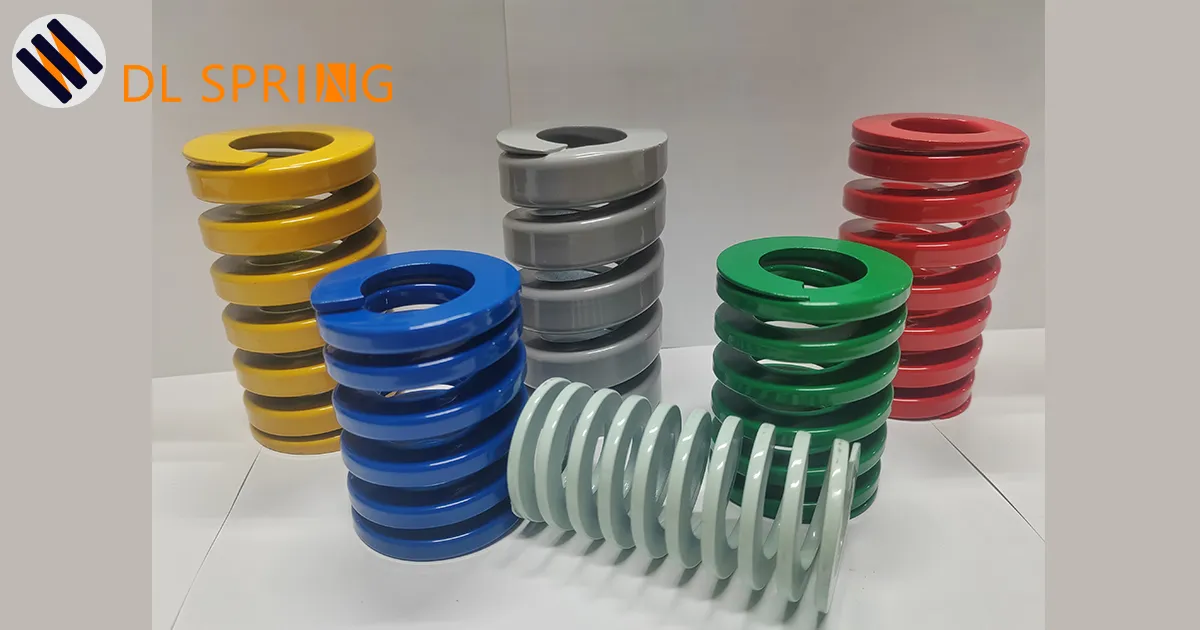
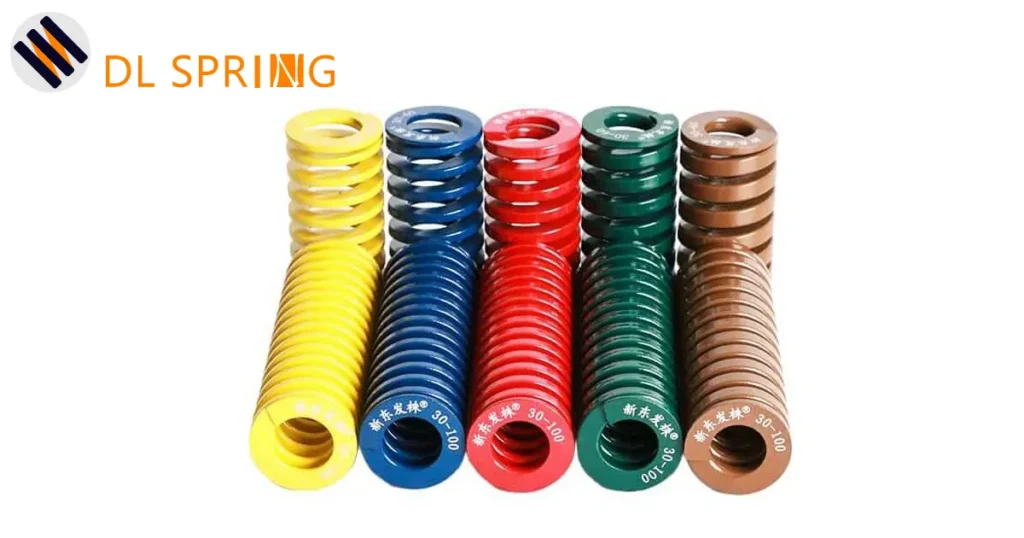
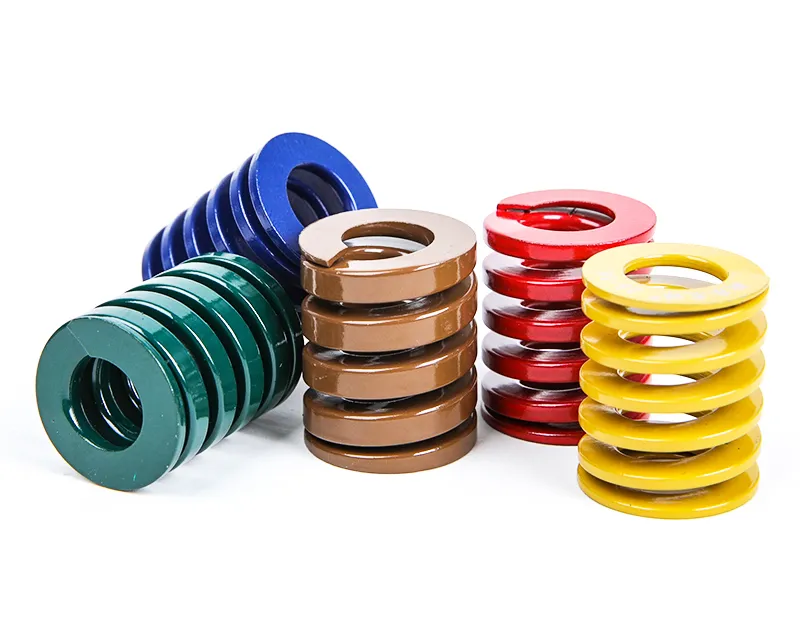
JIS die spring colors identify relative load classes within a spring series: yellow is extra light, blue is light, red is medium, green is heavy, and brown is extra heavy. Color helps you find the right family; the exact part number, dimensions, load at working height, and permitted deflection determine whether a spring fits your mold.
Use the chart below to identify a spring, then check preload, operating stroke, and the manufacturer’s data sheet before ordering. If you already know the size and series, browse our JIS die springs and send the required working loads for confirmation.
JIS Die Spring Color Chart
| Color | Common load class | Common catalog maximum-deflection reference* | Selection focus |
|---|---|---|---|
| Yellow | Extra light | 50% of free length | Lower force and longer available travel |
| Blue | Light | 40% of free length | Check both return force and travel |
| Red | Medium | 32% of free length | Balance force with available stroke |
| Green | Heavy | 24% of free length | Higher force with a shorter travel allowance |
| Brown | Extra heavy | 20% of free length | High force in a limited installation space |
*These percentages are identification references, not universal safe working limits or life guarantees. Catalog series can use different maximum, long-life, or test-deflection values. Use the specification for the exact spring you are buying; a long-life working limit may be lower than its catalog maximum. Never compress a spring to solid height as a working condition.
For an example of supplier-specific ratings, the TOHATSU product specifications listed by MISUMI distinguish maximum deflection by series. Those specifications do not establish the performance of a Dingli part. Confirm the applicable Dingli drawing or data sheet for an order.
Why Color Alone Cannot Identify a Replacement
A color is not a force value. Two red springs with different free lengths, diameters, or wire sections can have different rates and working loads. A faded coating can also make identification unreliable. Record the old part number, free length, outside diameter, inside diameter or guide-rod size, and loads at specified heights.
Color conventions also differ across standards. In the ISO 10243 color system, green denotes light load and yellow denotes extra-heavy load. Copying the color of a JIS spring into an ISO purchase order can therefore produce a very different selection. Compare dimensions and force–deflection data before changing systems.

Calculate Total Deflection, Including Preload
Preload is the initial compression when the spring is installed. During the working cycle, additional travel compresses it further. Both contribute to the maximum deflection that must be checked against the data sheet.
- Preload deflection = free length − installed length
- Total maximum deflection = preload deflection + additional working stroke
- Compression ratio (%) = total maximum deflection ÷ free length × 100
Illustrative example: a spring with an 80 mm free length is installed at 75 mm and moves another 20 mm during operation. Preload is 5 mm; total deflection is 25 mm; the compression ratio is 31.25%. Using only the 20 mm operating stroke would incorrectly give 25%. The 31.25% result must still be checked against the selected series, target life, and minimum operating length.
For an approximately linear spring, force increases with deflection according to its spring rate. Confirm the required force at both the installed position and the maximum working position. Our spring stiffness and load–deflection guide explains how to read that relationship.
Compression Limits and Fatigue Life
A maximum-deflection figure does not by itself promise 300,000, 500,000, or 1,000,000 cycles. Fatigue results depend on the exact design and material, minimum and maximum loads, preload, operating speed, temperature, guidance, and test conditions. A table from one manufacturer or series cannot be transferred to another solely because the colors match.
When comparing suppliers, ask whether each quoted deflection is a working recommendation, a tested endurance condition, or a physical limit. Compare the same operating conditions and acceptance criteria. For demanding cyclic service, agree on sample testing and a maintenance plan rather than extrapolating a cycle guarantee from a color chart.
Select a Spring for Your Mold or Die
- Confirm the installation space. Measure the housing bore, guide rod, free-length allowance, installed height, and minimum operating height. Allow the clearances specified for the selected spring.
- Define the loads. Specify the force needed at the installed and working positions. The mold designer should determine ejection or return requirements from the mechanism; part weight alone is not enough.
- Calculate preload and total travel. Include tolerances and the actual motion of the spring seat.
- Choose the series and load class. Check its load table or measured curve at your working heights, then verify its permitted travel.
- Confirm the duty. Provide cycle target, operating speed, temperature, corrosion exposure, and any side loading.
- Validate the assembly. Check guidance, seating, force balance, and clearance from coil contact before production.
If standard sizes do not meet those conditions, request custom spring production from a drawing or sample. A heavier color is not an automatic solution to insufficient stroke; it usually requires a separate check of travel and force.
Installation and Replacement Checks
Keep spring seats aligned and use the guidance specified by the tool and spring drawings. Preload and guide clearances are design inputs, so a single “1–2 mm for every spring” rule is not appropriate. In an assembly intended to share load evenly, use matched specifications and check whether the complete set needs replacement. Different rates should only be combined when the mechanism was designed for that load distribution.
- Check for cracks, corrosion, rubbing marks, and evidence of coil contact.
- Compare unloaded length and measured loads with the approved drawing and acceptance limits.
- Investigate uneven return, changed working loads, or repeated breakage before fitting replacements.
- Set inspection and replacement intervals from duty, condition, and validated life data; a universal monthly or yearly schedule is not enough.
Material and Manufacturing Information to Confirm
Material grade, heat treatment, finish, dimensional tolerances, and load tolerances should be stated for the supplied product. Do not infer them from coating color. Where traceability or fatigue evidence is required, specify the certificate, inspection record, or test report needed with the quotation. A material name alone does not establish corrosion resistance, temperature suitability, or service life.
Frequently Asked Questions
What do the five JIS die spring colors mean?
In the common five-color convention, yellow is extra light, blue light, red medium, green heavy, and brown extra heavy. These are relative load classes within a compatible series, not fixed force values.
Is a green JIS spring equivalent to a green ISO spring?
No. Green commonly indicates heavy load in the JIS convention and light load in the core ISO 10243 convention. Verify the standard, dimensions, rate, working loads, and travel before substituting.
How much can I compress a JIS die spring?
Use the limit published for the exact part and operating duty. Include initial preload in total deflection. The chart’s common reference percentages do not replace a series data sheet or guarantee fatigue life.
Can I choose a spring from color and free length alone?
No. You also need the housing and guide dimensions, installed and minimum working heights, and required force at those positions. The existing part number and a drawing or sample are useful for cross-reference.
What should I send for a quotation?
Send the standard or part number, dimensions, quantity, installed height, working stroke, required loads, cycle target, and operating environment. Add a drawing or sample details and any inspection requirements.
Confirm Your JIS Spring Selection With Dingli
Cixi Dili Spring Co., Ltd. has manufactured springs since 1995 and supports custom production from drawings or samples. For selection or replacement, send your dimensions and working loads through our contact page, email [email protected], or WhatsApp +86 13586942004. We can review the requested series and identify the information needed to confirm a suitable spring.