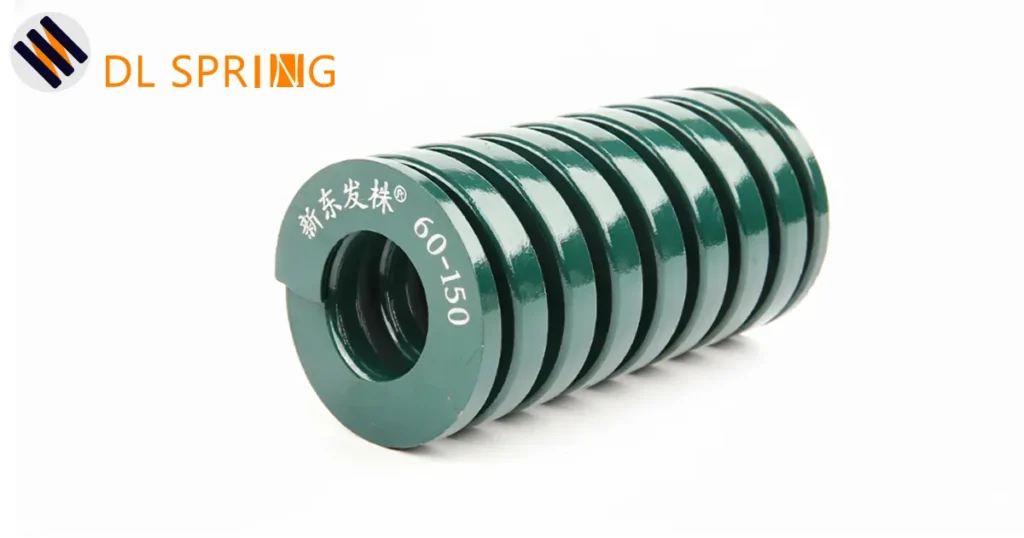
Die spring fatigue life is one of those numbers buyers wish they could just look up. The catalog says a million cycles for light load, several hundred thousand for heavy load, and the project moves on. Then the tool goes into production, springs start breaking earlier than expected, and the team is left arguing whether the catalog was wrong or the application was outside its envelope.
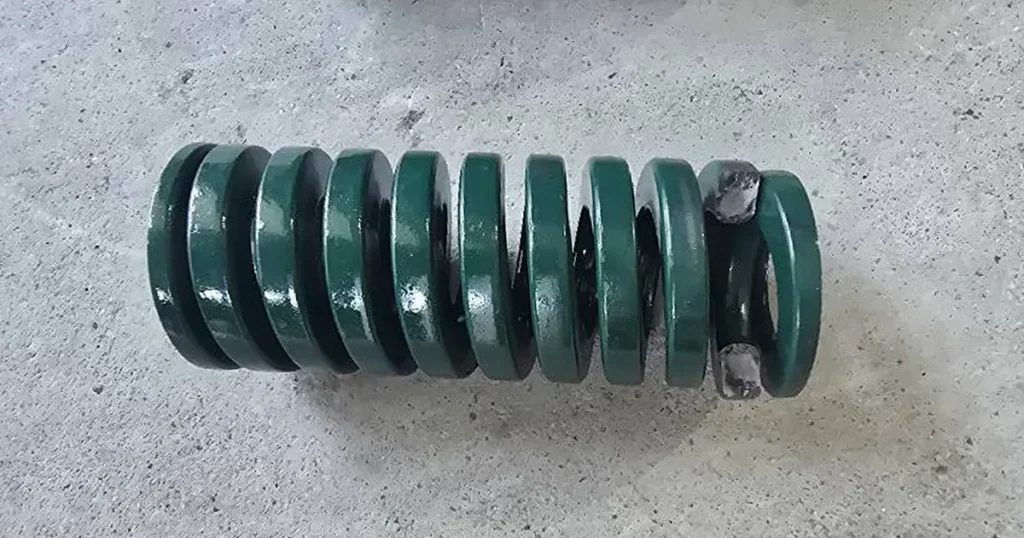
Most of the time, neither is fully wrong. The catalog cycle number is a reference under specific deflection assumptions, and the application is rarely identical to those assumptions. A more useful question, before locking a tooling run, is whether the service life estimate matches how the spring will actually be used.
If you are still selecting between standards or load levels, it helps to first review the basic die springs page and align on what color or load class the project actually needs.
Why catalog cycle numbers do not transfer cleanly to your tool
A cycle rating in a die spring catalog is usually published with assumptions about installed deflection percentage, alignment, end-coil contact, and clean operating conditions. Real tooling projects rarely match all four at once.
- Deflection is often pushed higher than the rated percentage because designers want fewer or shorter springs.
- Alignment may be acceptable on the drawing but compromised in actual installation.
- End coils may run against rough or uneven seating surfaces.
- Operating conditions can include heat, contamination, or lubricant that the catalog never assumed.
Each of these factors quietly reduces the effective cycle count. None of them are unusual; they just compound.
What “fatigue life” actually means in a die spring context
For a die spring, fatigue life is not just “how long until it breaks.” It usually means the cycle count before the spring loses a defined amount of free length or load. By the time a spring visibly fractures, it has often been operating below specification for many thousands of cycles. That is why a tool can produce parts that look acceptable while springs are already drifting.
Useful service-life thinking covers three things, not just one:
1. Cycle count to load loss
This is what a buyer typically cares about when scheduling spring replacement, because the press starts to behave differently before any visible failure.
2. Cycle count to free-length loss
Free length drift changes preload and clearance. A press can keep running, but tolerances on the formed part start to move.
3. Cycle count to fracture
Fracture is the worst case and often the latest event. Designing replacement intervals around fracture is unsafe; intervals should be set around load and length drift instead.
How to use color codes and load classes without overtrusting them
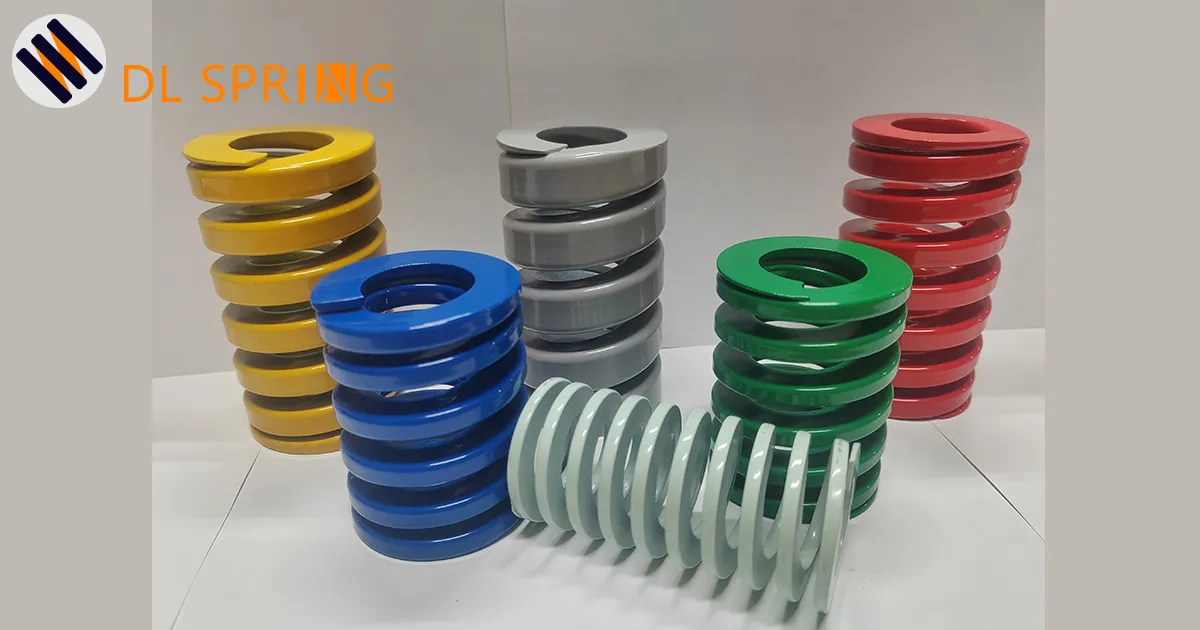
Most die spring color codes correspond to a load class — light, medium, heavy, extra heavy, and so on. They are useful as a shorthand, but they describe stress level, not absolute service life. Two springs of the same color can produce very different cycle counts depending on installed deflection and operating conditions.
A practical way to use color codes in fatigue planning:
- Treat the color as a stress class, not a guaranteed life.
- Pick a class with a deflection envelope that fits the actual stroke, not the maximum stroke on paper.
- If the design forces high deflection, drop a class rather than push the existing one harder.
- Confirm the color-to-class mapping with the supplier, since standards and brands do not always agree.
For more on the standards behind these classes, the article on die spring product range is a good starting reference.
Why a sample run is not a real fatigue test
It is common to install a small batch of springs, run a few thousand cycles, see no issue, and treat that as confirmation. This is one of the most expensive mistakes in tooling.
A short sample run mostly proves the spring fits. It does not prove fatigue behavior, because:
- most fatigue degradation is not visible in the first few thousand cycles
- load loss is gradual and only meaningful when measured before and after
- thermal effects, contamination, and edge alignment build up over longer runs
- a press cycling slowly under sample conditions does not match production tempo
If the project requires real confidence in service life, it is more useful to instrument a longer run and measure free length and load at planned intervals, not to rely on visual inspection alone.
What buyers should confirm before committing to a tooling run
Before locking the spring selection for a production tool, it is worth confirming:
- installed deflection at maximum stroke, expressed as a percentage of free length, not just in millimeters
- the load class assumption and whether it leaves a margin for wear and minor misalignment
- expected duty cycle: how many strokes per shift, how many shifts per day
- operating temperature near the spring, especially in hot stamping or near welded structures
- whether replacement is planned by cycle count or only after visible failure
These points usually take one short conversation, but they decide whether the project lives with steady spring behavior or chases problems for months.
Common patterns that shorten die spring life
Several recurring patterns show up across tooling projects:
- upgrading to a heavier color class without reducing deflection
- using a shorter spring at higher deflection to save space
- installing springs against rough or uneven seats that load the end coils unevenly
- mixing springs from different lots or brands in the same tool
- not tracking how many cycles the springs have already seen, especially after tool transfers
None of these are dramatic. They are routine decisions that usually look harmless on the drawing.
When custom is more honest than buying heavier standard
If the design is forcing a standard die spring beyond a comfortable deflection range, switching to a heavier color class often only delays the problem. In those cases, a custom geometry — different wire ratio, different load curve, or a different installation interface — can solve the underlying mismatch instead of patching it.
Buyers running this kind of project usually benefit from starting with the custom spring route rather than going through several rounds of heavier standard parts that still under-deliver on life.
Frequently Asked Questions
Is the cycle number on a die spring catalog reliable?
It is reliable as a reference under the catalog’s deflection and condition assumptions. It is not a guarantee of life in your specific tool.
Can I extend life by simply choosing a heavier color class?
Sometimes. But if the underlying issue is over-deflection or alignment, a heavier class may break later but still earlier than expected.
How do I tell if a die spring is failing before it fractures?
Track free length and load periodically. Drift in either is usually a clearer signal than waiting for visible damage.
When does it make sense to design for custom die springs instead of standard?
When standard color classes cannot give a reasonable deflection envelope, or when installation space and load curve do not align with any catalog item.
Work With Dingli
Cixi Dili Spring Co., Ltd. has supported die spring production since 1995, including standard color-class items and project-driven custom solutions. If you need help estimating a realistic fatigue life envelope before committing to a tooling run, review the die spring product range, explore aftertreatment options, or start from custom spring support. For project discussion, contact [email protected] or WhatsApp +86 13586942004.