Open any European-built press tool and the die springs inside it are color-coded for a reason. Under ISO 10243 — the international standard for rectangular-section compression springs used in pressing tools — the color is not decoration. It is the fastest way for an engineer to read the spring rate, estimate the available load in a given bore, and avoid dropping a too-soft or too-stiff spring into a pocket that was sized for something else. The problem is that the same colors mean different loads in JIS and American systems, and a few widely sold grades sit just outside the four official ISO colors. Get the system wrong and you face premature fatigue, set, or a tool that simply will not develop the force it needs.
This guide explains the ISO 10243 color logic the way a tooling engineer actually uses it: what each color represents, how load and travel trade off, where the extended “extra-light” and “extra-heavy” grades fit, and how to select or replace a European die spring without guessing.
What ISO 10243 Actually Standardizes
ISO 10243 is titled “Tools for pressing — Compression springs with rectangular section — Housing dimensions and colour coding.” First published in 1991 and revised through 2010 and 2019, it does three jobs that matter on the shop floor:
- Housing dimensions. It fixes the hole (bore) diameter and the guide-rod diameter so a spring from one ISO supplier drops into a pocket machined for another ISO supplier.
- Free length and tolerance. It defines free lengths and the tolerance on them, so stacked or paralleled springs behave predictably.
- Color coding by spring rate. It assigns a color to each load class and sets the maximum recommended working stroke for that class.
The wire itself is rectangular (trapezoidal in cross-section on many modern designs), which is what lets a die spring deliver far more force in a short, confined space than a round-wire compression spring of the same outside diameter. That higher energy density is exactly why press tools, clamping units, ejector systems, and stamping dies rely on them. If you want the broader background on how this family differs from ordinary coil springs, our overview of die springs is a good starting point.
The Four Core ISO 10243 Colors
At its heart, ISO 10243 defines four load classes. For any given bore and free length, the color tells you the relative stiffness: how much force the spring develops per millimeter of deflection.
| Color | Load class | Relative spring rate | Typical use |
|---|---|---|---|
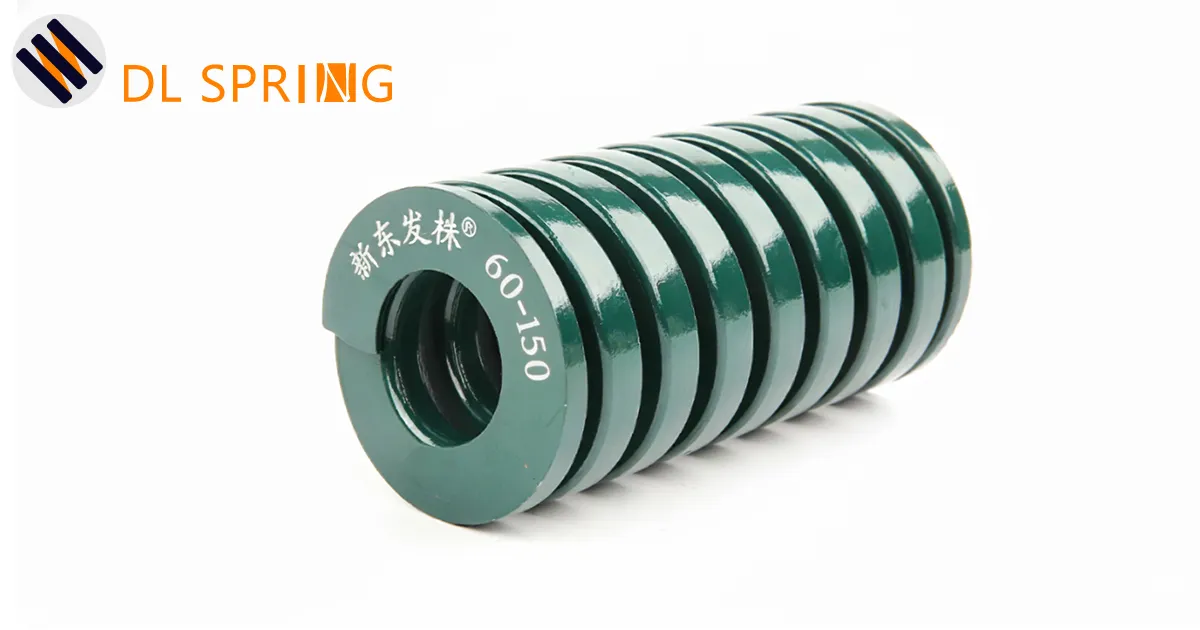
| Green | Light load | Lowest of the four | Long-stroke, fatigue-sensitive jobs; pilots, strippers, sensors |
| Blue | Medium load | Moderate | General-purpose stamping, blank holders, balanced load/life |
| Red | Heavy load (strong) | High | Higher clamping force in the same bore; shorter stroke |
| Yellow | Extra-heavy load (extra-strong) | Highest of the four | Maximum force in a fixed pocket; short, hard-working strokes |
The logic is consistent: as you move green → blue → red → yellow, the spring gets stiffer and the safe working stroke gets shorter. A green light-load spring is built to travel a long way many times; a yellow extra-heavy spring is built to develop maximum force over a short, controlled stroke. Pushing a heavy-rate spring to the deflection you would happily use on a light-rate spring is one of the most common causes of early failure.
Where Light Green and Grey Fit: The Extended Grades
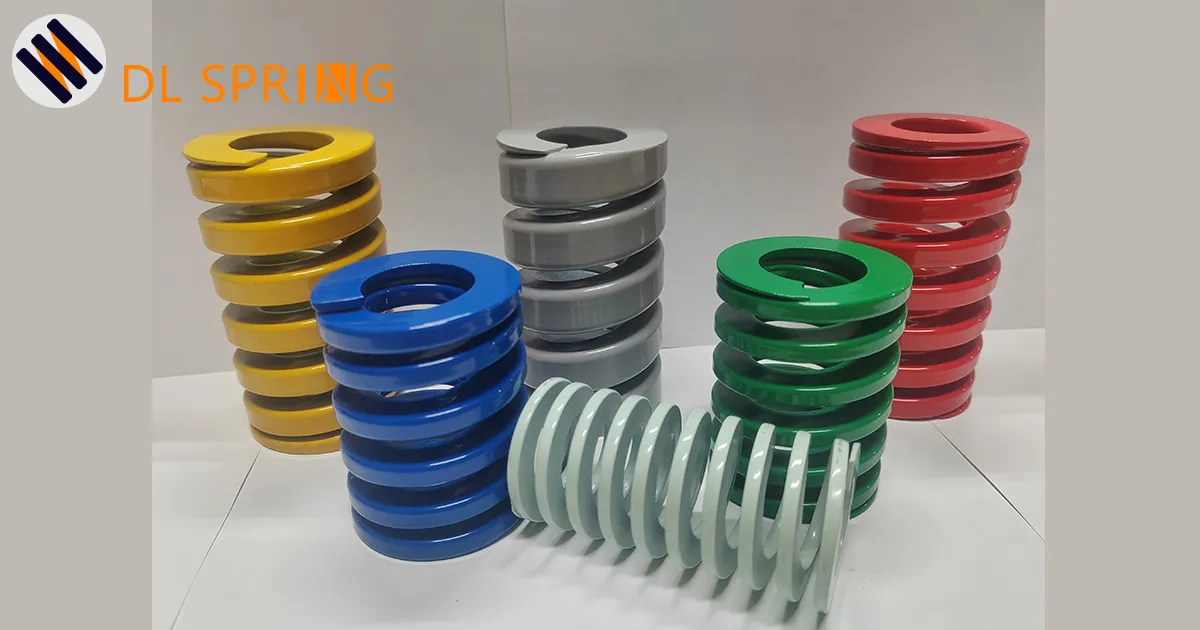
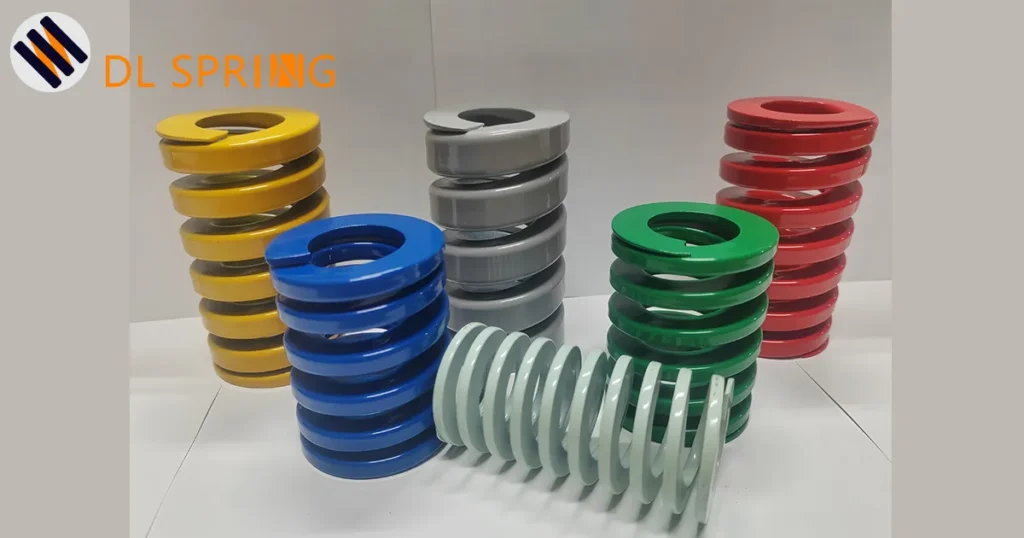
In real catalogs you will also see light green and grey die springs sold alongside the ISO four. These are extended grades that bracket the standard rather than additional official ISO colors:
- Light green — extra-light load. Sits below green. The softest rate with the longest permissible travel, for very fatigue-sensitive or long-stroke positions where even a light-load green spring would be too stiff.
- Grey — extra-extra-heavy load. Sits above yellow. The stiffest practical grade, for cases where a fixed bore must produce more force than even an extra-heavy yellow spring can deliver.
So a full, practical European-style range reads as a six-step ladder from softest to stiffest. At Dingli we identify these in the DL series as DLF (light green, extra-light) · DLL (green, light) · DLM (blue, medium) · DLH (red, heavy) · DLB (yellow, extra-heavy) · DLG (grey, extra-extra-heavy). The four middle grades follow the ISO 10243 color convention; the light green and grey ends extend the range so you can match a difficult pocket without changing the bore.
| Step | Color | Dingli DL code | Load class | ISO 10243 status |
|---|---|---|---|---|
| 1 (softest) | Light green | DLF | Extra-light | Extended grade |
| 2 | Green | DLL | Light | Core ISO color |
| 3 | Blue | DLM | Medium | Core ISO color |
| 4 | Red | DLH | Heavy | Core ISO color |
| 5 | Yellow | DLB | Extra-heavy | Core ISO color |
| 6 (stiffest) | Grey | DLG | Extra-extra-heavy | Extended grade |
The single most useful habit: never select on color alone. Color narrows the field; the published force-versus-deflection figure for that exact bore and free length is what you actually design to.
Load vs. Travel: Reading the Trade-Off Correctly
Every die spring class carries two numbers that matter more than the color: the maximum working stroke (the most you should ever compress it) and a longer-life working stroke (the deflection you design to when you want high cycle count). ISO 10243 publishes a maximum stroke per class, and stiffer classes get a smaller percentage.
As a representative pattern across the range — exact figures depend on the specific series and free length, so always confirm against the data sheet:
- Lighter classes (light green, green) tolerate the largest deflection — commonly up to roughly 38–40% of free length at maximum, and around 25% for long-life duty.
- Medium (blue) sits in between, typically a few points lower on both numbers.
- Heavier classes (red, yellow, grey) tolerate the least — often around 30% maximum and roughly 20% for long-life duty.
This is the heart of correct selection. If your application needs a long stroke at high cycle counts, a softer color used within its generous travel window will outlive a stiffer color forced into the same travel. If you need brute force in a short stroke, a heavier color is the right tool. The color system is really a map of this load-versus-life compromise.
Why ISO, JIS, and US Colors Are Not Interchangeable
This trips up a lot of cross-standard sourcing. The same color means a different load in each system, and the dimensions and travel ratings differ too. A red ISO spring is not a red JIS spring. Three reasons engineers must verify before substituting:
- Different bore and rod dimensions. ISO 10243 housings are not identical to JIS or US pockets, so a “matching” color may not even fit the hole and guide rod.
- Different load-per-color. Each standard assigns its colors to its own rate ladder. Matching color across standards does not match force.
- Different durability basis. ISO 10243 travel is commonly referenced near 1.5 million cycles, JIS die springs near 1 million, and US die springs on a different cycle basis. Comparing rated travel without normalizing the cycle basis is misleading.
If you are weighing systems against each other, compare them deliberately rather than by color. Our breakdowns of JIS die springs and US die springs lay out where each fits, and we can cross-reference an existing part to the correct ISO equivalent on request — by recalculating load and travel, not by copying the color.
How to Select an ISO 10243 Die Spring
A reliable selection sequence for a European-standard die spring:
- Fix the pocket. Confirm the bore (hole) diameter and the guide-rod diameter. This sets the spring’s outside and inside diameter and rules out anything that will not fit.
- Set free length and installed height. The difference defines your preload; the working stroke during the cycle defines total deflection.
- Define the force you need at the working point — not just at maximum compression.
- Pick the color/class whose force-versus-deflection curve delivers that force within its long-life travel window, not at its absolute limit.
- Check life. If the duty is high-cycle, bias toward a softer color used in the lower part of its travel range; if it is force-critical and short-stroke, a heavier color is appropriate.
- Confirm environment. ISO die springs in Cr-V / 50CrV4-type alloy steel typically run up to about 200 °C; higher temperatures, corrosion, or special media call for a different material or finish.
Surface condition matters more than many buyers expect, because die-spring fatigue almost always starts at the surface. The right shot-peening and coating choice extends life significantly — see how we approach surface treatment for spring durability.
Common Mistakes With European Die Springs
- Selecting on color alone. Two springs of the same color but different free length deliver very different forces.
- Over-compressing a heavy color. Red, yellow, and grey have the smallest travel windows; treating them like a green spring causes set and early fracture.
- Assuming cross-standard color equivalence. ISO ≠ JIS ≠ US for the same color.
- Mixing colors in a parallel set. Different rates share load unevenly, overloading the stiffer spring.
- Ignoring preload. A spring installed with too little preload can surge or lift; too much wastes available stroke.
If your drawing specifies a color and a bore but you are unsure the travel and force actually match the duty, that is exactly the point to have it checked. A custom die spring built to your installed height and target force removes the guesswork when a catalog grade lands between two colors.
Frequently Asked Questions
Does ISO 10243 officially define six colors?
No. ISO 10243 standardizes four load classes — green (light), blue (medium), red (heavy), and yellow (extra-heavy). Light green (extra-light) and grey (extra-extra-heavy) are extended grades many manufacturers add to bracket the standard range, including our DLF and DLG grades.
Which color is the strongest?
Among the four ISO colors, yellow (extra-heavy) is the stiffest. If an extended grey/extra-extra-heavy grade is offered, it sits above yellow. Remember that “strongest” also means the shortest safe working stroke.
Can I replace a JIS or American die spring with an ISO spring of the same color?
Not safely by color. The bore, rod, free length, load-per-color, and cycle basis all differ between standards. Match by recalculating fit, force, and travel for your installation — we can cross-reference a part for you.
How much can I compress an ISO die spring?
Stay within the published maximum stroke for that class, and design to the longer-life stroke for high-cycle work. Lighter colors allow more travel (roughly up to 38–40% maximum); heavier colors allow less (around 30%). Always confirm against the specific series data sheet.
What material and temperature limit apply?
ISO die springs are commonly made from chrome-vanadium / 50CrV4-type alloy steel rated to around 200 °C. For higher temperature, corrosive media, or special cleanliness, ask about alternative materials and surface finishes.
What information do you need to recommend the right spring?
Bore (hole) diameter, guide-rod diameter, free length, installed height, working stroke, target force at the working point, cycle expectation, and operating environment. With those, we can confirm the correct color and grade.
Work With Dingli
Choosing a European die spring is about matching force and travel to your pocket and duty cycle — the color is the shortcut, not the answer. If you are selecting a new ISO 10243 spring, cross-referencing an existing JIS or US part, or need a grade that falls between two colors, send us your bore, free length, installed height, and target load and we will confirm the right class or build a custom solution.
Talk to our engineering team via the contact page, email [email protected], or WhatsApp +86 13586942004. Founded in 1995, Cixi Dili Spring Co., Ltd. supports custom production from your sample or drawing across R&D, production, and sales.